Tag Archives: Barbara Walker

Barbara Walker…week 10

Wow, it is a big book…but I am not going to cave…yet.  I am learning a lot while I do this project.  I thought, after 50 years of knitting, 40 of which I would call myself a fairly active knitter, that I would have pretty much covered knitting.  I was wrong.  I guess sometimes before, I would just reject stitches willy nilly.  Now, with this project, I am not allowed to.  For those of you that don’t know, I am trying to design (ooo.. did I just call myself a designer?) knitted items using the stitches as they present themselves in a book that was published a couple of years after I started knitting, A Treasury of Knitting Patterns by Barbara Walker, 1968.  It has 500+ stitches in it.  My ‘rule’ is that I can use one or more stitches from any chapter or combination of chapters, but it must be the next stitch after the previous one I used in that chapter. I can, of course, throw in stockinette stitch and/or garter stitch whenever I feel the design requires it, otherwise things may get a little busy.  Not that I am usually averse to busy.  I am sure no one is keeping track, but there are some UFO’s (say it ain’t so, gill) and a couple of things I put in my knitting guild’s annual challenge, which I will show you next week when I get them back that represent some in between stitches.

first attempt

first attempt

back of first slouch

back of first attempt

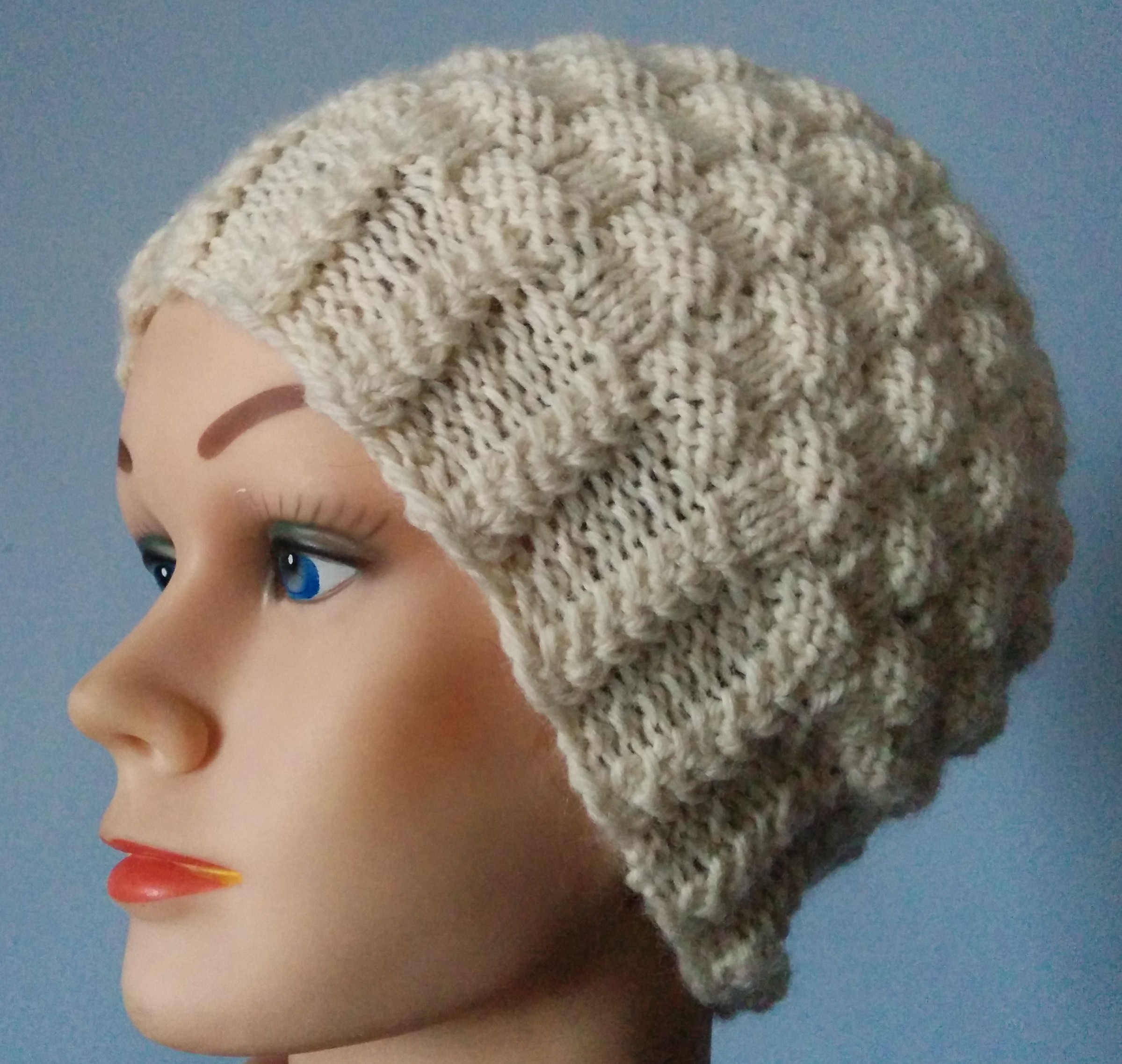
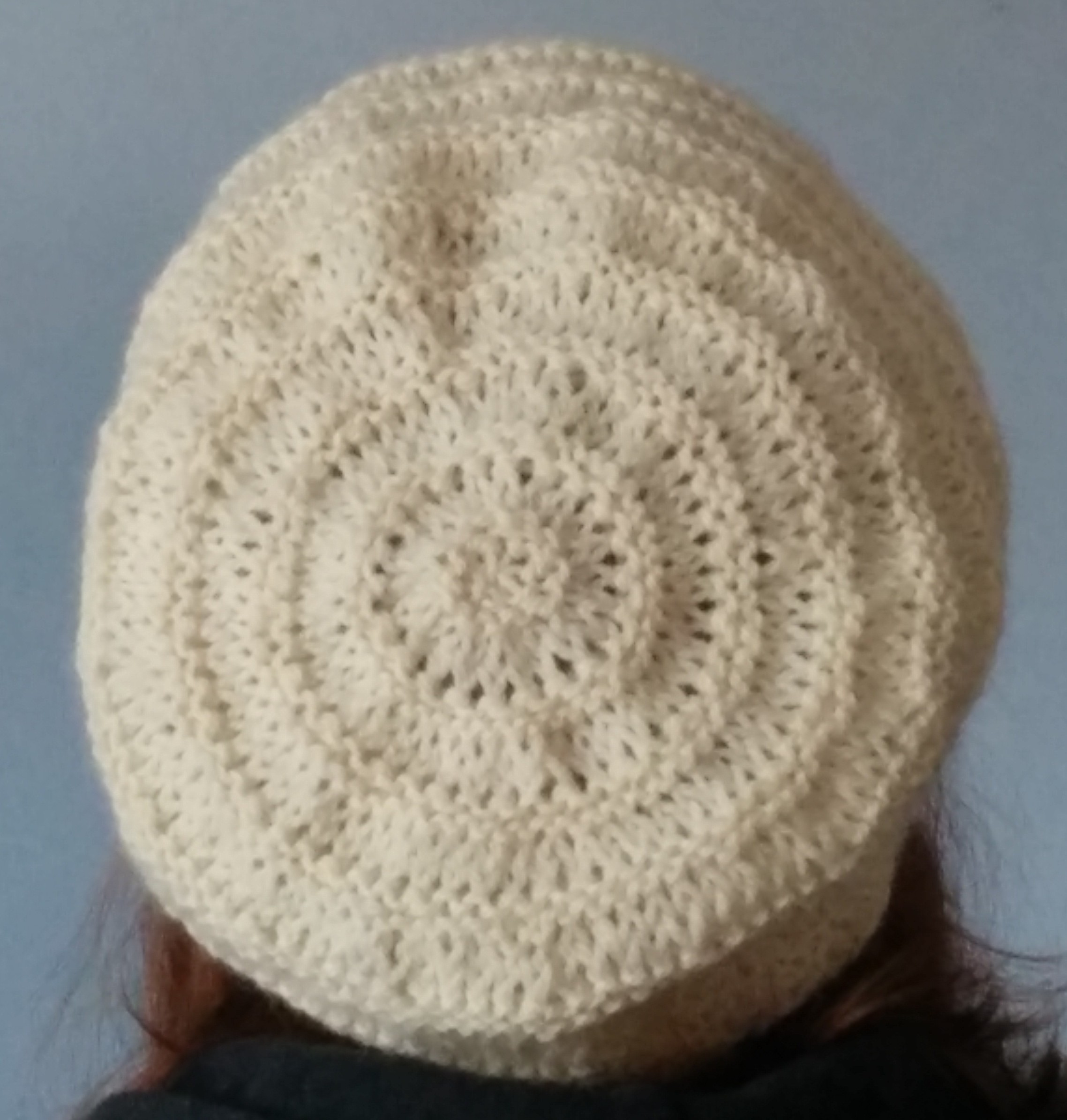
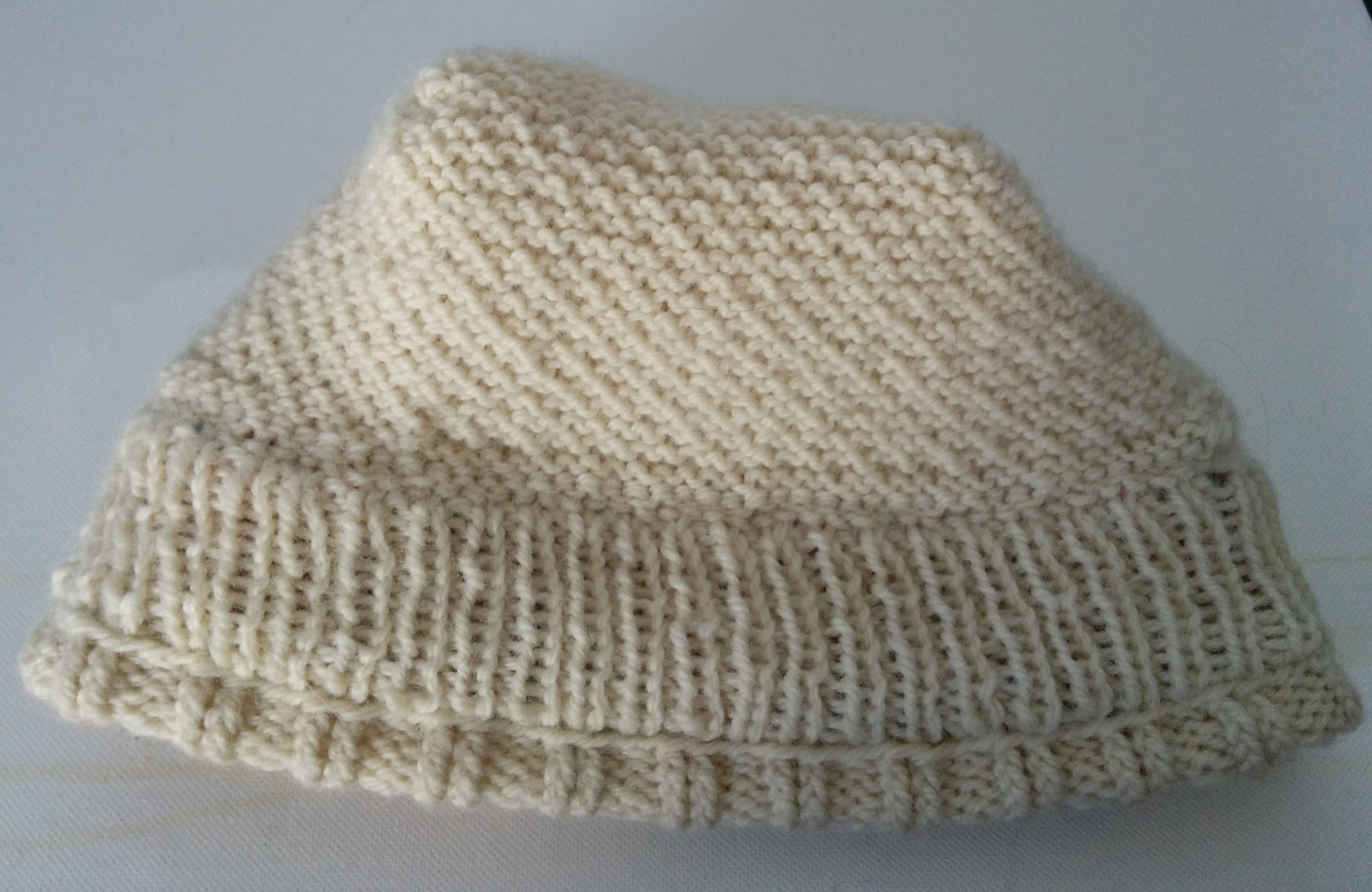
This week was not a very productive week, partly because I have another baby sweater almost finished and the two hats I did finish have patterns that eat stitches for breakfast.  I hope it is obvious I was going for rasta-style hats here.  Last time, I did the colours, this time the shape.  I can’t say Barbara didn’t warn me that these stitches (Waffle stitch or Rose Fabric, pg 129 – purl version on the first hat and seed stitch version on the second hat) spread laterally, making a wider piece than you would expect.  She wasn’t kidding.  The first one is large and you would need a major set of dreds to fill it out.  I reduced the number of stitches by 10% (from 110 to 100) on the second one and it doesn’t seem to be that much smaller.  It took me a LONG time to get used to this stitch and, like lace, you have to go back stitch by stitch for a couple of rows before you recover your place if you have to rip back.  Which I did.  Several times.  The decreasing is weird because you keep knitting into the row below and collapsing the fabric, so the decreases become compressed.
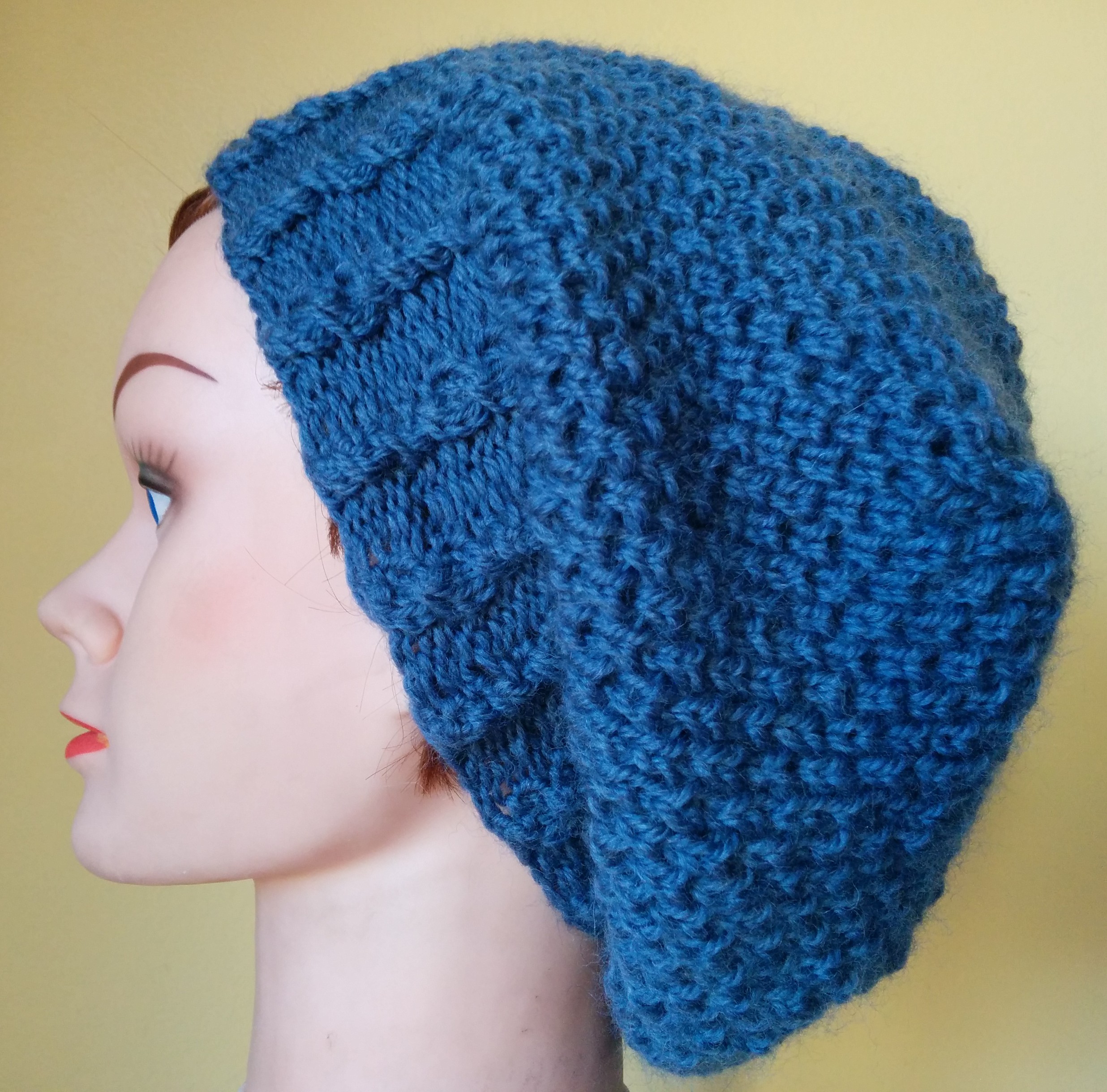
second attempt

second attempt

back of second attempt

back of second attempt

I also used Mock Wave Cable, pg 115 on the first hat and Figure Eight Twisted Ribbing, pg 43 on the second hat.  Back to work today.  I am in the mills this week but next week I am joining the cooking unit, a change is a good as a rest as they say.  I will miss the guys, but I love new challenges.

Barbara Walker…week 9

Only two items this week…I haven’t really made baby sweaters since my kids were babies.  And we all know they are not that any more.  There are only two kids in the next generation so far and my sister Jane is a knitter herself, so there was no real point.  Gotta say, hats are WAY easier….there are so many more stitches in this sucker than any hat.  Also way more design choices, potential problems.  Having to rip back a few times only adds to the psychological issues.  I probably should have aimed for newborn size instead of the second size, less knitting….BUT, I used three whole stitches from “THE BOOK” (A Treasury of Knitting Patterns. Barbara Walker. 1968).  Wheat Ear Rib, pg 43, Cloverleaf Eyelet Pattern, pg 169, and Eccentric Cables, pg 241.  I thought I had been making too many hats, and I needed to leave my wheelhouse for a bit.  I have made over 200 hats without patterns now and I make design choices almost automatically, for good or ill.  It almost never takes longer than walking to the kitchen to make a coffee to get me unstuck anymore.  Also, I couldn’t figure out how the wheat ear rib would be done in the round.  I think I have figured it out, but I thought it was cheating if I wasn’t sure it was the same stitch exactly.  I have to follow my own arbitrary, fictitious rules on this project, after all.  gillianknits.com

I have an issue at the back of the collar.  We are going to Toronto this week to pick the kids up from university, so I will try to visit the only grandniece I have and see how bad the problem is.  I am pretty sure I can jury rig it easily enough.  I am pretty vigilant these days about writing down the hat patterns, but I figured this was a dead loss and I quit writing it down somewhere near the middle of the raglans.  I am not really fussed about the look of the raglan edge, but better done than perfect as someone used to say.  A lot.

...a wam hug

…a wam hug

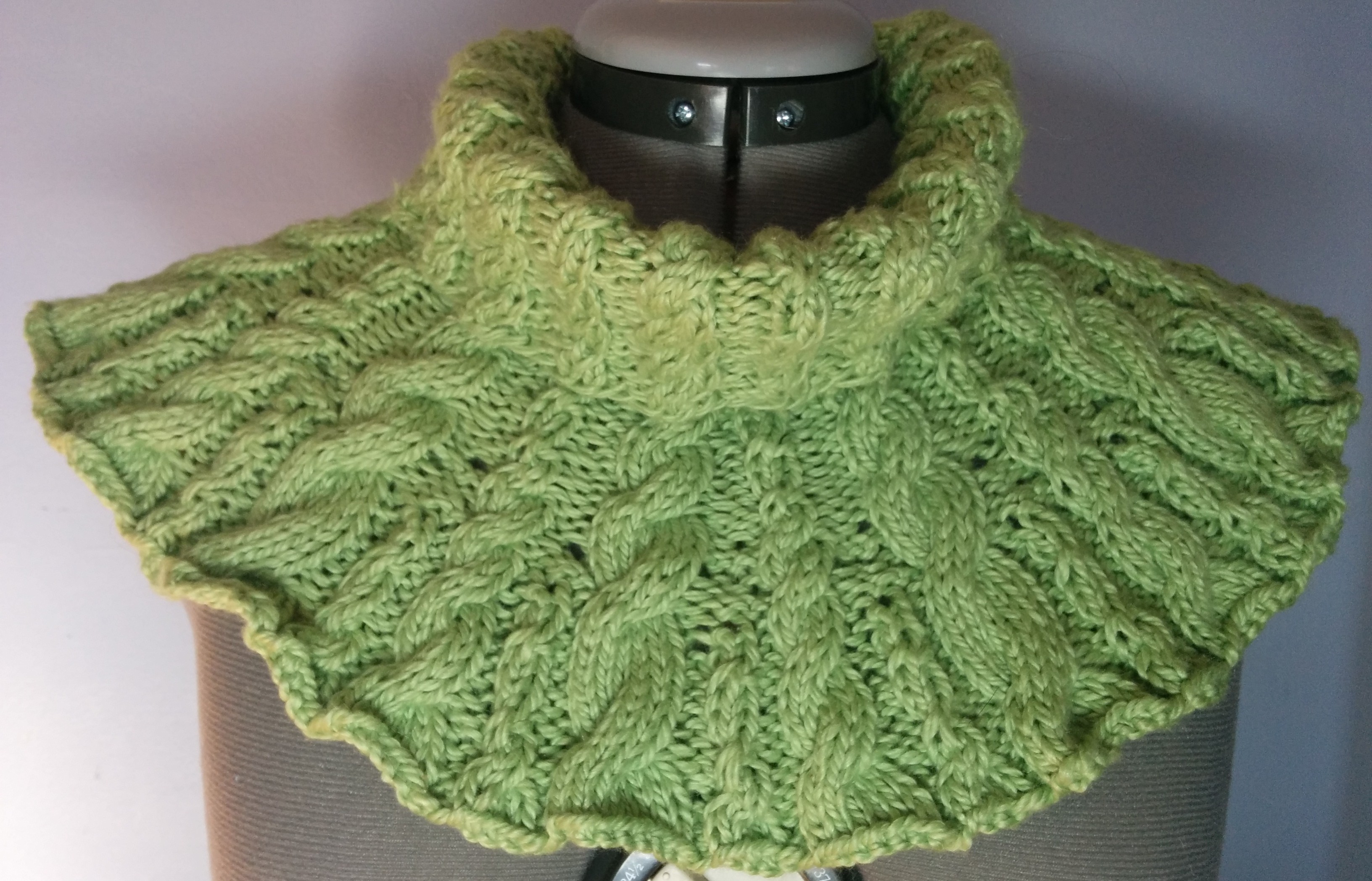
On our way home from Quebec City, we stopped in Plessisville at the Brassard et Fils weaving supply store  Near the cash they had this (sadly discontinued) Misti Cotton which is a blend of pima cotton and silk.  It felt so soft I couldn’t leave it there, so I bought three skeins.  I immediately knew that I wanted to make neck warmers with it.  I also knew that I had to break into the cable chapter, so I did this to use up a whole bunch of different cables.  I started at the bottom of the collar part with Classic Mock Cable, pg 115 and Four Stitch Cable Crossed Every Fourth Row, pg. 241.  Just before the collar part finished, I turned around as if to do a short row so that I flipped back and front.  I continued down the yoke part turning the mock cable into 4 x 4 cable then 6 x 6 cable.  I turned the 4 x 4 cable into 6 x 8 cable then 8 x 10 cable.  I was just trying to constantly increase as I went along.  I had measured and knew that I had to end up with about 2 1/2 times as many stitches at the bottom of the yoke as I had on the collar part.  I created new cables between the old ones which started as mock cables and transitioned into 4 x 4’s. At some point I was REALLY glad I wasn’t trying to follow someone else’s pattern instructions because I would have had to think too much.   With the baby sweater, this takes care of all the simple cables….yeah!  And it feels like a warm hug so, double bonus points.

Barbara Walker… week 8

Jah Rastafari

Jah Rastafari

Heather was home last week between classes and exams.  She mentioned that she will be going to a scout moot next weekend with the theme “Reggae vs DIsco”.  I immediately thought “do I have a stitch for you!”.  I knew this, Tricolor Wave Stripes, was the next stitch in Chapter Four, Color-Change Patterns.  It may have been good  to do another slouch, but it is difficult to get slouchy with such a dense stitch.

My next hat went from COLOUR! back to white, It uses Basketweave from Chapter Two, simple Knit-Purl Combinations and Braided Rib from Chapter Three, Ribbings.

Braided Rib and Basketweave

Braided Rib and Basketweave

I tried my best to stay in the pattern as I decreases at the top, but it was difficult to maintain the integrity of the stitch whilst decreasing the number of stitches per pattern repeat.  I don’t mind the top, but I think the basketweave got lost.

disappearing the basketweave

disappearing the basketweave

My last hat of the week uses Reverse Cross-Stitch Ribbing in combination with Mock Cable Rib (as suggested in the book).  I also broke into Chapter Nine, Eyelet Patterns with Zigzag Eyelet Pattern below the Simple Eyelet Pattern.

gillianknits.com

I played a bit with the top from last week.  Disappearing 14 stitches toward each other in four sections.  This time when I got to the top of this part, I continued up with slip 1, knit 2 together, psso to the top.  Not actually that much different than the top last week’s hat.

disappearing eyelets

disappearing eyelets

I didn’t get too far this week because my knitting guild challenge is due tonight and I had to finish up my entries on the weekend. My entries are very much also-rans this year, but someone has to lose, right?


Barbara Walker….week 7

Black and white sampler-side view

Black and white sampler-side view

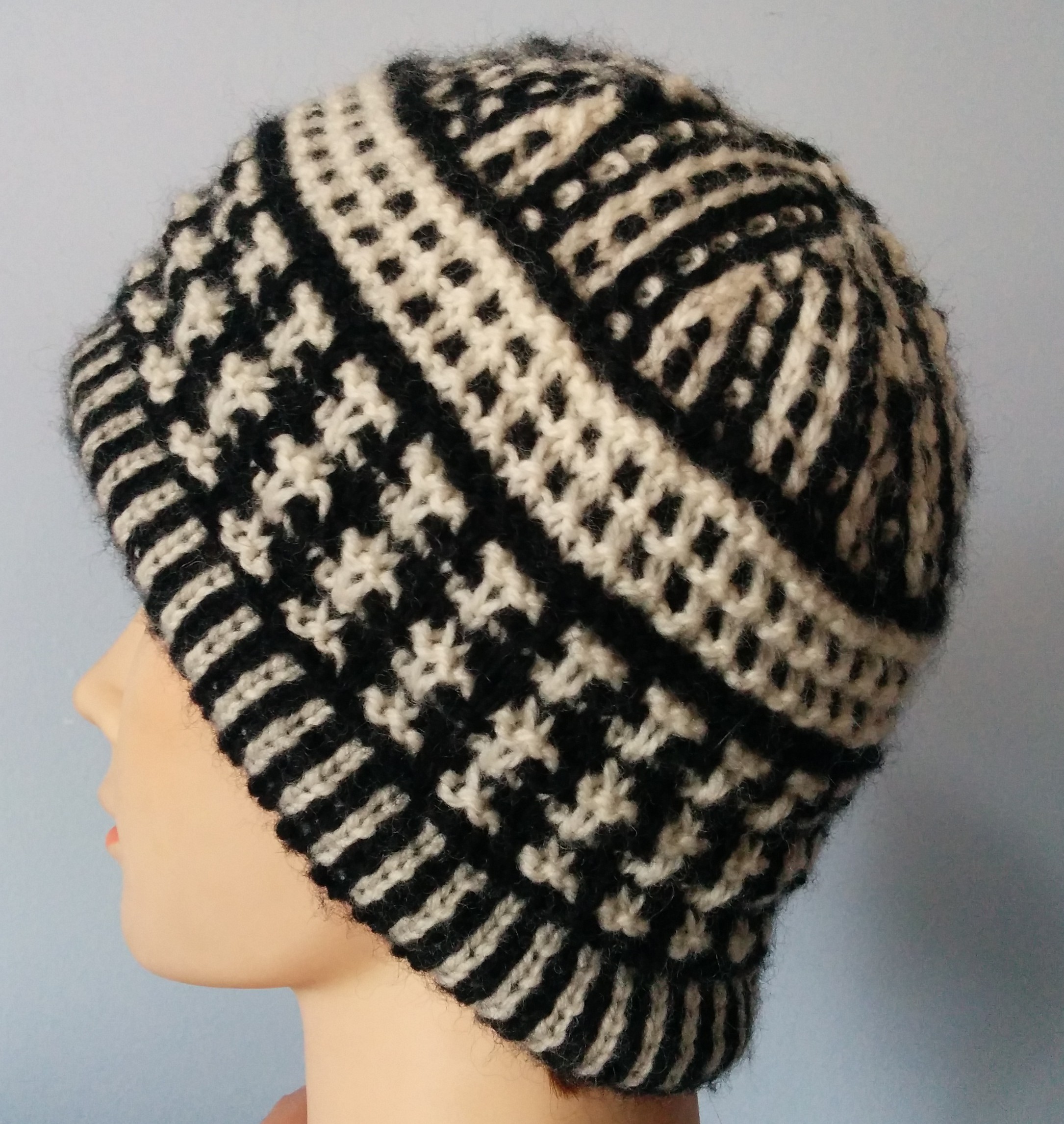
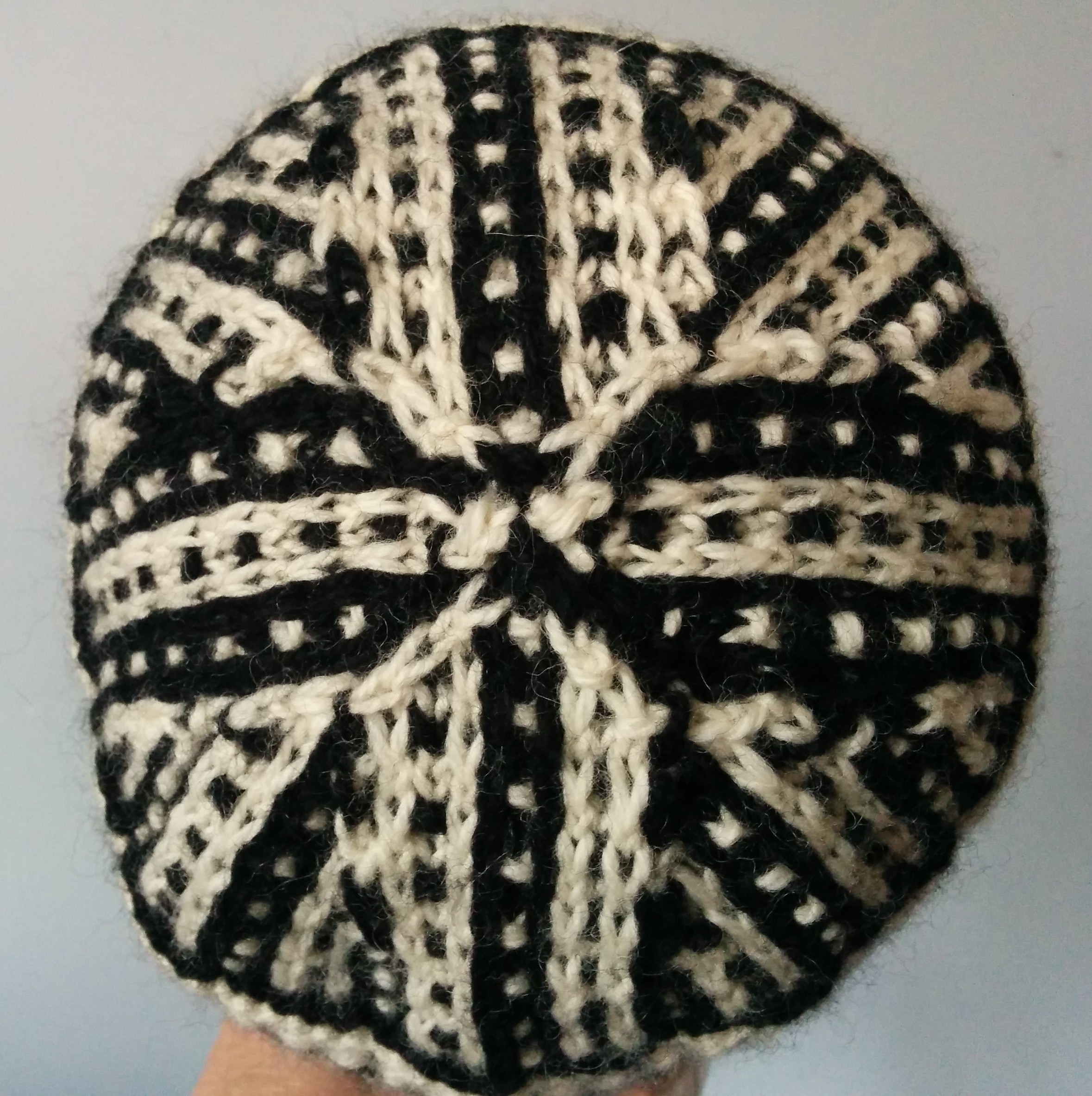
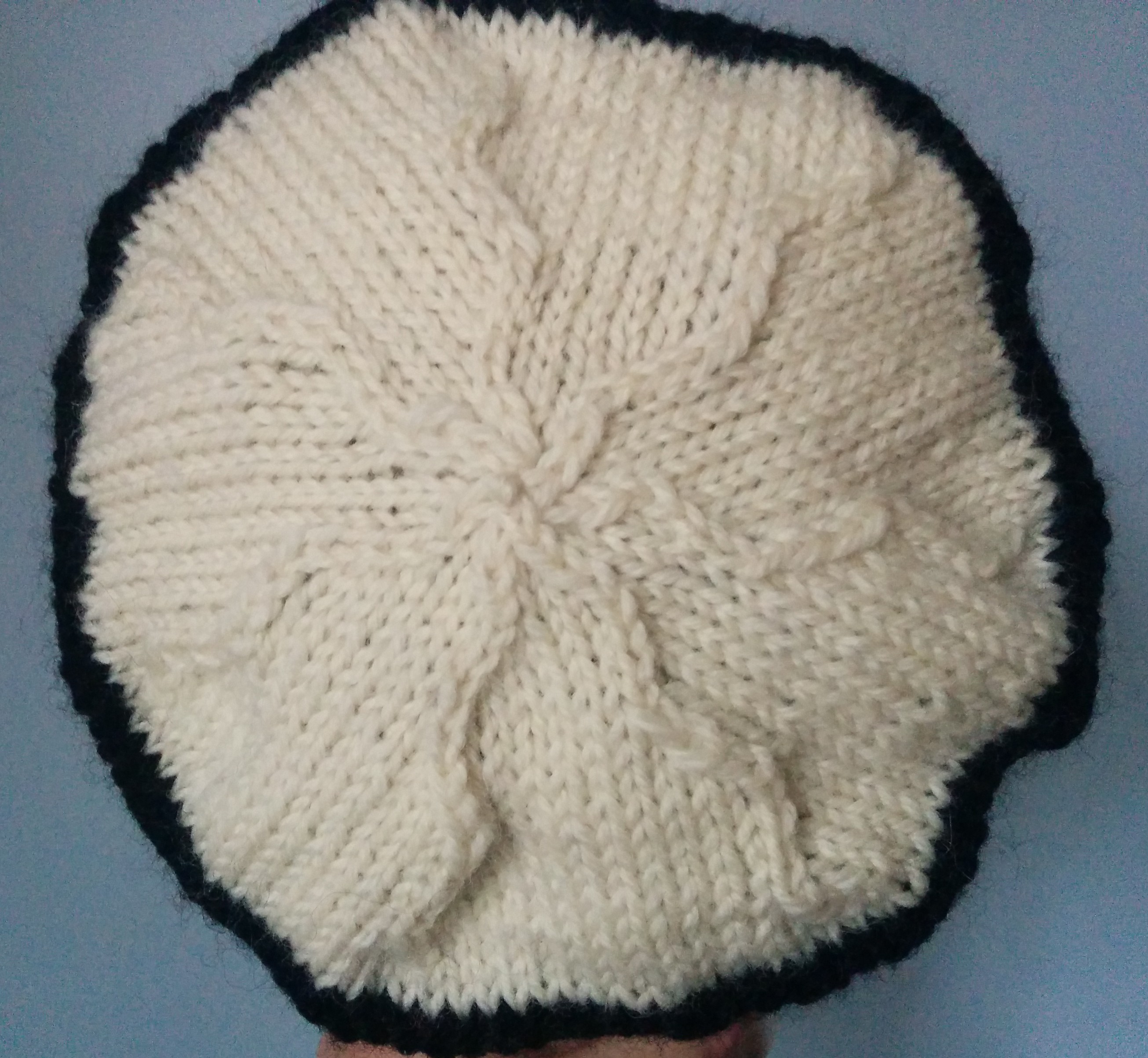
For these first two hats, I cast on 108 stitches using Patons Classic (worsted weight) wool and 4 1/2 mm needles.  I like 108 stitches if I am doing something that pulls in a bit, like cables or colour work.  108 has a lot of ways to be divisible 3 x 36, 4 x 27, 6 x 18, 9 x 12. For more ordinary tension stitches, I usually cast on about 100 stitches, which covers stitch repeats of 4 or 5 nicely. or 98 or 105 for a stitch repeat of 7, 102 for stitch repeats of 6..  These first two hats used 9 different stitches, all from Chapter 4, Color-Change Patterns.  For the first hat I started at the bottom with Pin Stripe Pattern.  I did a total of 14 rows of each colour, then joined back in to the cast on edge.  I continued up the hat with Three-and-One Tweed, Corn on the Cob Stitch, Pin Check, Pin Check Variation, and finished with Waffle Check. I separated each section with a knit row, then a purl row of black.  I like how the hat fits and it is really cozy and warm…not that we need THAT any more this year, YEAH!!.  Here is the top of that first one:

Black and White sampler-top view

Black and White sampler-top view

I liked how the pinstripe looked, but I felt the band could be less puffy.   I experimented on the second hat and did 7 rows of knit 1, purl 1 ribbing before doing 8 rounds of each colour in the pinstripe pattern and joining back to the cast on edge.

Another black and white sampler

Another black and white sampler

I continued up this hat with Maltese Cross Stitch, Waffle Check Variation, and finished with Dotted Ladder Pattern.  I did a two stage decrease at the top, and I liked the effect (for each quarter of the hat, I decreased on 2/3 of the stitches with the decreases heading toward each other, then when these stitches were gone, did the same thing on the remaining stitches).

Another black and white sampler...top view

Another black and white sampler…top view

I was pleased with how that looked, so decided to do the same basic thing on my next hat, this time doing half the stitches first, then the rest, but without the visual distraction of the colours.

Quaker ridging slouch hat-back view

Quaker ridging slouch hat-back view

I like how this top looks, but unfortunately maybe not on the hat I did.  I used Little Hourglass Ribbing from Chapter 3, Ribbings for 14 rows, then switched to Quaker Ridging from Chapter 2, Simple Knit-Purl Combinations.  As I was knitting this hat, it struck me that it was a pretty flexible stitch and the purl sections might roll up like my socks from a couple of weeks ago, so I thought it might work well as a slouch hat, which I did.

Quaker Ridging slouch hat-side view

Quaker Ridging slouch hat-side view

Heather and my friend Jen both liked the slouch thing, so I decided to do another using Cross-Stitch ribbing and Banded Insertion Pattern.

Banded Insertion Pattern-side view

Banded Insertion Pattern-side view

J decided for this one to just let the stitch itself tell me how to reduce it, even though I still have some ideas related to the last cast off.  I will save them for the future.  I have made notes so I don’t forget.  I quite like how the back turned out.

Banded Insertion Pattern-back view

Banded Insertion Pattern-back view


Barbara Walker…week 6

silly little hat

silly little hat

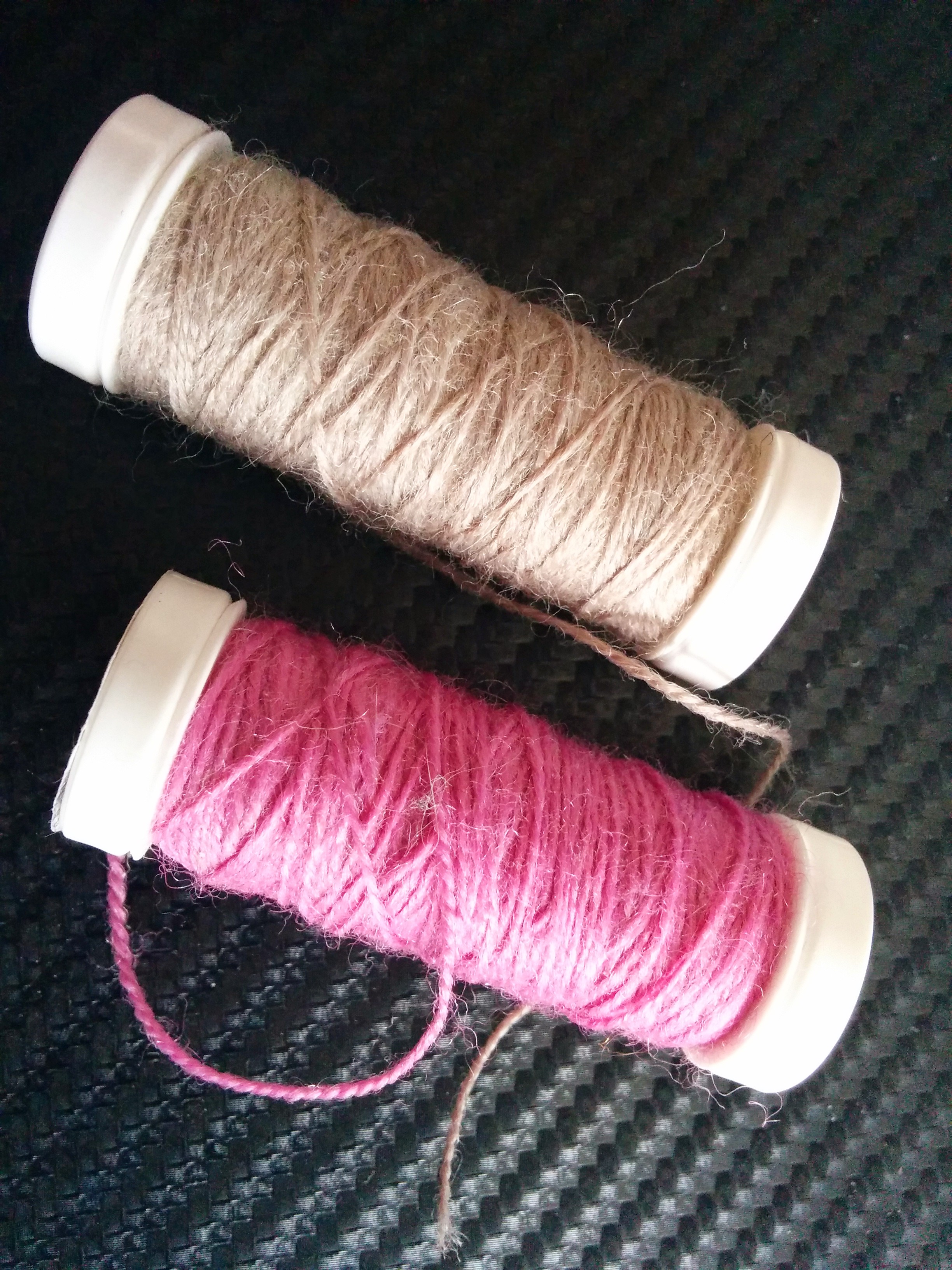
I kept looking at the beginning of Chapter Four, Colour Work, which starts with this pattern, Simple Vertical Stripes, and thinking “ugh!” This pattern reminds me of Phentex slippers and old ladies’ tea cozies. I decided that I had to bite it and get going because I actually love colour work and am looking forward to later things in this chapter. My compromise is to make a little hat which I can stick in the drawer of the doll’s dresser. It needs to be populated anyway. I used 1 mm (US 00000) needles and some knitting-in wool from spools I bought at one of my local wool stores.  Yarn Forward.


Little spools of wool

Little spools of wool

So now I am passed that little hurdle, I have made a couple of regular hats with some of the colour change patterns after that one.

 Two-Stitch Check/Four-Stitch Check Hat

Two-Stitch Check/Four-Stitch Check Hat

This hat uses the next two patterns in the chapter.  I redid the top four times before I left it.  I tried to disappear the stitches staying in the two-stitch check pattern several times before giving up and putting this top on it instead.  I used 9 points of decrease, decreasing on the white (knit) rows, alternating with plain rounds of black (purl).  I did another hat this way a month or so ago before I fired the blog back up.

Top view of Two-Stitch Check/Four-Stitch Check Hat

Top view of Two-Stitch Check/Four-Stitch Check Hat

I then carried on.  I really was not fussed about this, (Elongated Check) pattern, but it is OK on the hat, I think.  Better done than perfect, as they say.  Whoever THEY are.

Hat using Elongated Check Pattern

Hat using Elongated Check Pattern

This hat also uses the next stitch in Chapter 3, Ribbings- Embossed Moss Stitch Ribbing.  I played with disappearing the stitches in stockinette stitch on the top using 7 points of decrease. I did ssk at the beginning of each decrease section every row for 3 rows, did a row with no decrease, then did three rows where I did a k2tog at the end of each decrease section, followed by another plain row.  I alternated like this till I had nothing left.  I quite like how it looks.

Top of Elongated Check Pattern Hat

Top of Elongated Check Pattern Hat

That’s all she wrote for this week, better luck next time…

Barbara Walker…week 5

shaker fruit baskets from shakerworkshops.com

shaker fruit baskets from shakerworkshops.com

I had better get my skates on if I am actually going to get through the 500 or so patterns in this book…If I continue at four a week it could take upwards of 2 years! Oh, well, I will keep going till I am not enjoying the process any more.
Easter Basket hat

Easter Basket hat


This is the hat I did this week using Slip-Stitch Honeycomb from Chapter Five, Slip-Stitch patterns and Twisted Knit-two Purl-two Ribbing from Chapter Three, Ribbings. I decreased aggressively in four places to get the pointy bits that look like an upturned Shaker Fruit Basket…see image above.
Easter Basket Hat

Easter Basket Hat


This hat and mitt set are in a style I had been working on quite a bit earlier this year. I use random balls of novelty yarn from the discount bins and combine them with plain worsted weight yarn. I usually enclose the back of the novelty yarn with regular worsted yarn, because a lot of them are on the scratchy side, which is probably why they end up in the discount bins in the first place. For the Easter theme, I used a novelty yarn that had Easter Colours in it.
the inside of the Easter Basket hat

the inside of the Easter Basket hat


Last spring, I made a pile of hat and mitt sets, so I got pretty good at making mitts to match any hat I made. I decided in the interests of diversity, to include mittens to go with this hat. In order to use more stitches, they are not totally a set, but rather the mittens use Baby Cable Ribbing from Chapter Three, Ribbings and Woven Stitch from Chapter Five, Slip-Stitch Patterns. These mittens were quite popular with the waitresses this weekend, but maybe they were all just sucking up for tips.
n.b. If you are ever going to use woven stitch, add stitches. I increased from 40 to 46 from the ribbing to the body of the mitts and I could have done more, say 48 or 50, although they are not bad. I had to restart because I had not originally increased.
Easter Mittens

Easter Mittens

Barbara Walker … week 4

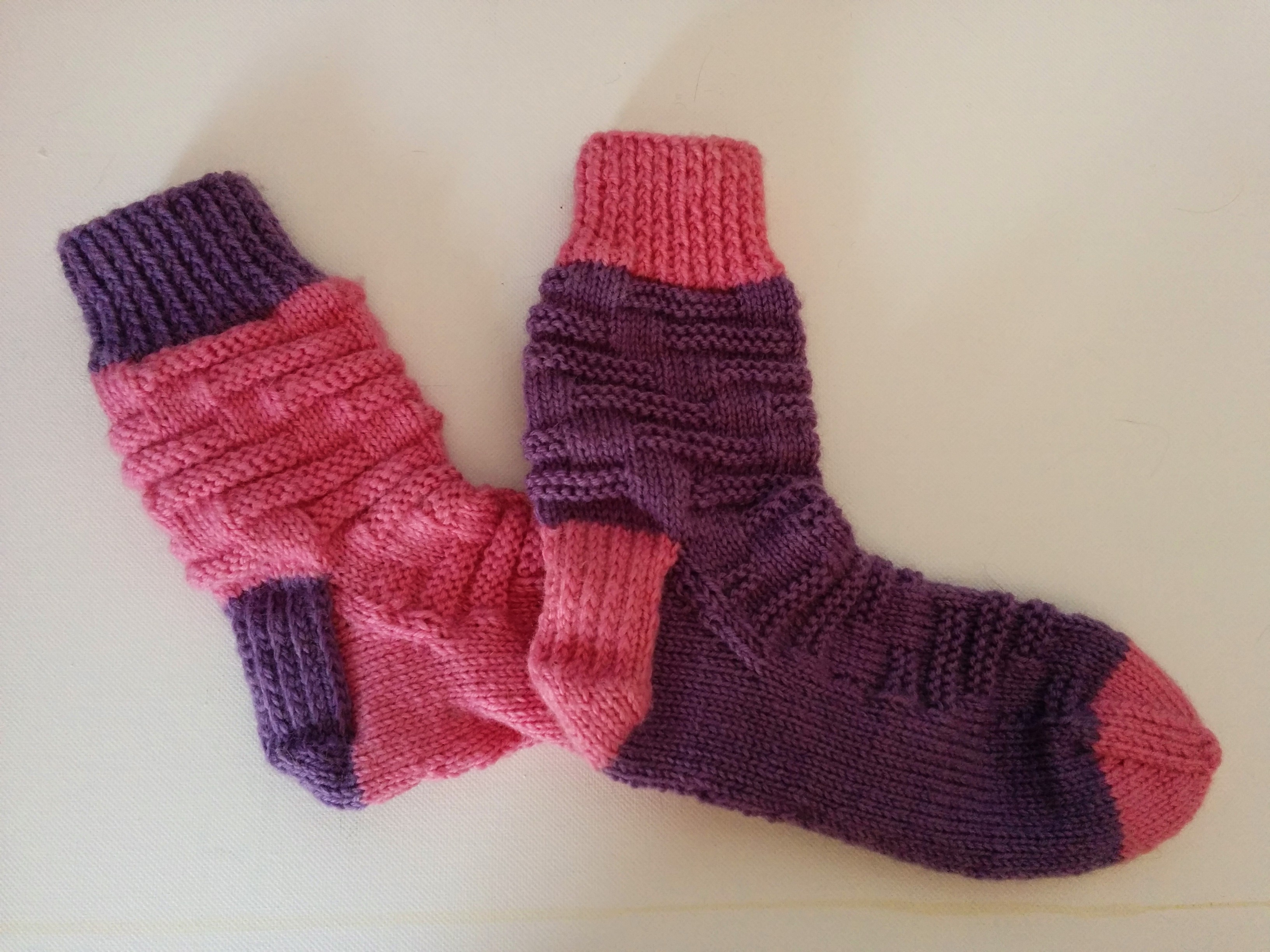
gillianknits.comIt struck me this week as I was making these socks that Julie had it OK. The only people who would know of the success or failure of her efforts were her husband, herself and the occasional dinner guest. Food was eaten and the dishes done each night. I, on the other hand, must photograph my knitting and show it to anyone who may want to look (granted, at this point, it is only a handful of people but the potential remains). When I saw this stitch, Escalator Pattern from Chapter 2, Simple Knit-Purl combinations, I immediately thought socks. It was not a great thought as it turns out. I must admit, I am not a sock expert by any stretch of the imagination. I, and I say this with trepidation given the esteem with which sock knitting is held, have never really believed in knitting socks. Gasp. When I saw my mum do it as a child, I saw how little time they lasted and felt sorry for her. With 8 kids, she didn’t have a lot of knitting time, so it had to count. Sweaters, hats and mitts were passed from one child to the next, but socks developed holes in what seemed like no time. I have been told that this is because the knitting was too loose and she should maybe have used a smaller needle, but old prejudice dies hard and I have probably only made about 5 pairs before.
Heather and I have worn slightly different socks on each foot for a long time. If we got one of those batches of socks that had a different colour stripe, we would often wear two different colours together. She went as far as to get mad at Alan if he sorted the laundry and matched the like colours together. I understand from the talk in the change room at fitness that this is a common practice amongst “the youth”-many aquafitness participants having grandchildren. I wanted to do something like this in these socks.
I changed the stitch in the second sock (the purple one) as an experiment. A few stitches after the Escalator Pattern in the book, Walker talks about how, if you are doing several rows of reverse stockinette stitch. you may want to switch it to garter stitch to reduce curl. I decided that on the second sock, I was going to do this because there was a real tendency for the sock to slouch, not a good thing in a sock. In fact when I was knitting the pink one, manatees and Michelin men kept coming to mind. Barbara Walker must have blocked the swatch before photographing it in the book, you have to really tug on the pink sock to make it look like the sample. In the purple sock, instead of three rows where purl appears on the front, I switched it to two rows of purl with a knit row between, turning the reverse stockinette into garter. It actually looks a lot more like the example in the book than the real stitch. These socks also used Crossed Knit-One Purl-One Ribbing from Chapter 3, Ribbings and Heel Stitch from Chapter 5, Slip-Stitch Patterns. They are DK weight.

right side out, with upturned brim

right side out, with upturned brim

from the top with right side out

from the top with right side out

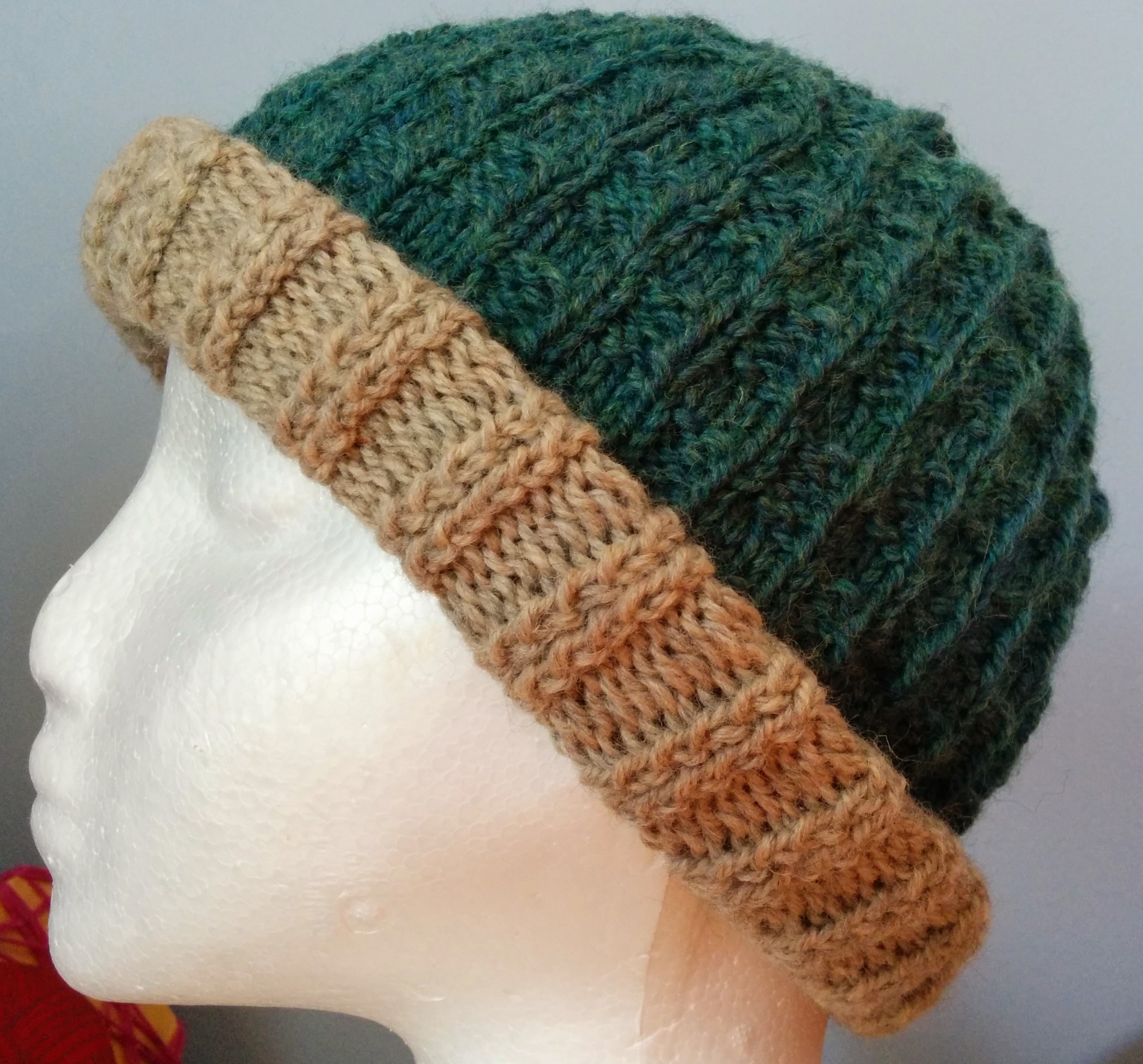
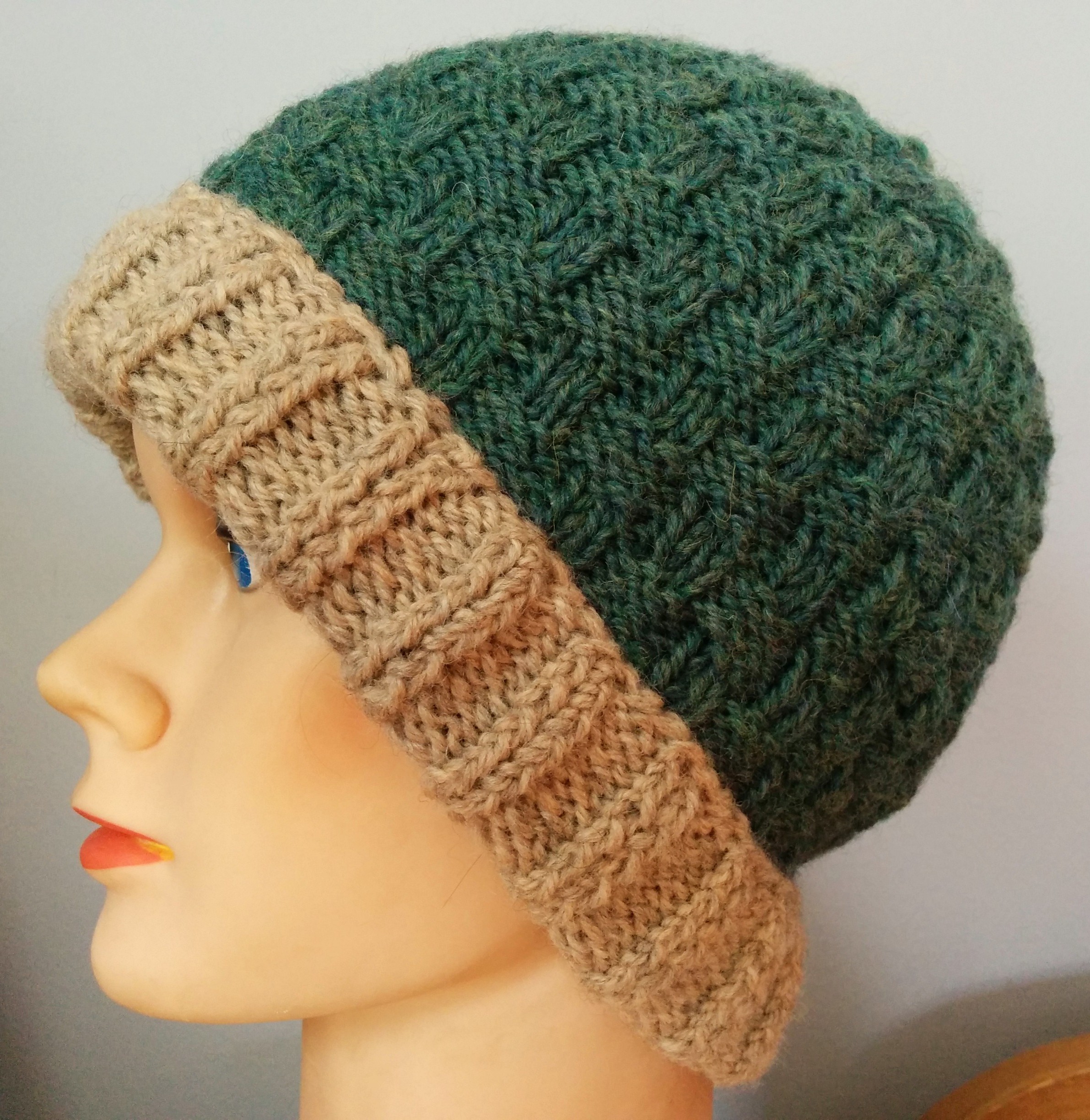
This hat incorporates Crossed Knit-Two Purl-Two Ribbing from Chapter 3, Ribbings and Waving Rib Pattern from Chapter 2, Simple Knit-Purl Combinations. She mentions that the back of the stitch is nice too, so I made the hat reversible. Here is the inside. I think I like the “inside” better, especially the top.
inside out, with brim down

inside out, with brim down

inside out from the top

inside out from the top


I made one more hat this week using Mistake-Stitch Ribbing from Chapter 3, Ribbings and Slipped-Stitch Ridges from Chapter 5, Slip-Stitch Patterns. I really like how the top worked out on my second try (frogged the first one).
gillianknits.comgillianknits.com