Tag Archives: knitted hat

Let it snow…

Jane with snowflakes

Jane with snowflakes

We had a LOT of snow overnight and all of a sudden we are living in a winter wonderland again,,,until the snow gets dirty anyway.  I love seasons.

This is a hat I always thought worked out OK.  I was waiting for snow to show it.  I like how the variegated adds a bit of interest.  I also think the i-cord rose is nice in the variegated.  See instructions for rose.  And of course you can’t go wrong with off white to show off the cabling…

Top view

Top view

Elegant fireworks…i-cord ropes

Heather in Elegant Fireworks...i-cord edition

Heather in Elegant Fireworks…i-cord edition

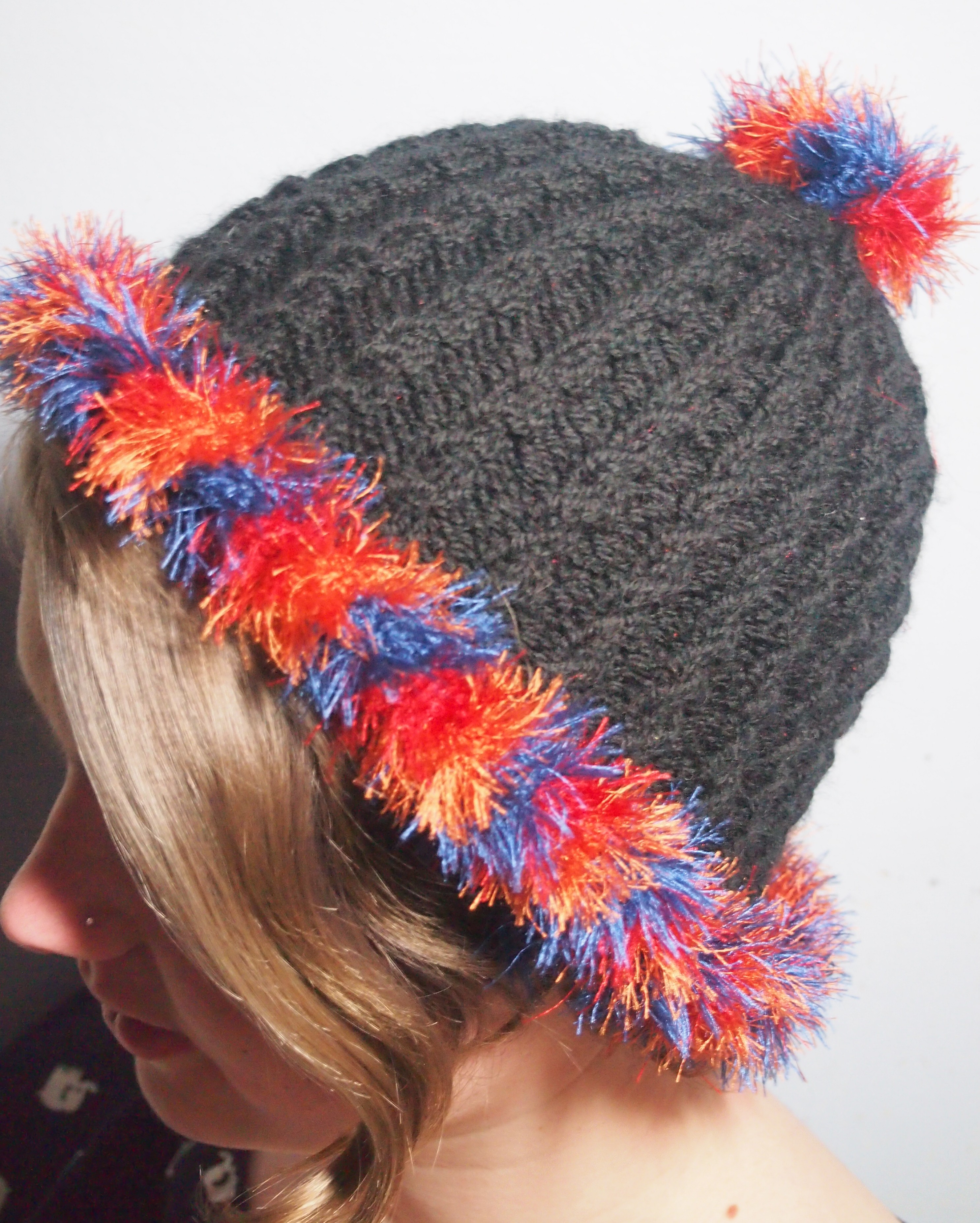
This, the 3rd edition of the elegant fireworks series. (see the first and second) (and I STILL haven’t finished the balls of eyelash yarn!).  This one uses i-cord to make a rope effect around the bottom and top.

I knit the basic hat casting on 104 stitches and doing a k2, p2 with a fake cable every 4th row (k2tog then knit first stitch again on each of the k2’s).  I stopped when I had decreased to 18 stitches to make the top

To make the i-cord rope along the cast on edge, I used the eyelash yarn and with the first colour, I picked up and knit into the first 3 stitches along the cast on edge, then used them to make a 3 stitch i-cord for 12 rows.  I reduced to one stitch with a  slip one, k2tog psso. I left this while I worked with the other two colours.  I used the next 3 cast on stitches to make an i-cord with the second colour, then reduced to one stitch and left it too.  I used only 2 stitches from the cast on edge and picked a stitch up between them for the third colour and made a third 12 row i-cord

attach third colour into place

attach third colour into place

I then took the first i-cord and brought it in front of the other two and picked up into the next two cast on stitches and made a new I-cord.  I then brought the second colour over and in front and picked up two stitches…I continued until I had gone around and joined into the beginning,

For the top, I did the same technique, using live stitches instead of picking up from the cast on edge.  For the first i-cord of each colour, i used two live stitches and picked up a third between them.

More twisting and twirling

Meg in one with frost flowers

Meg in one with frost flowers

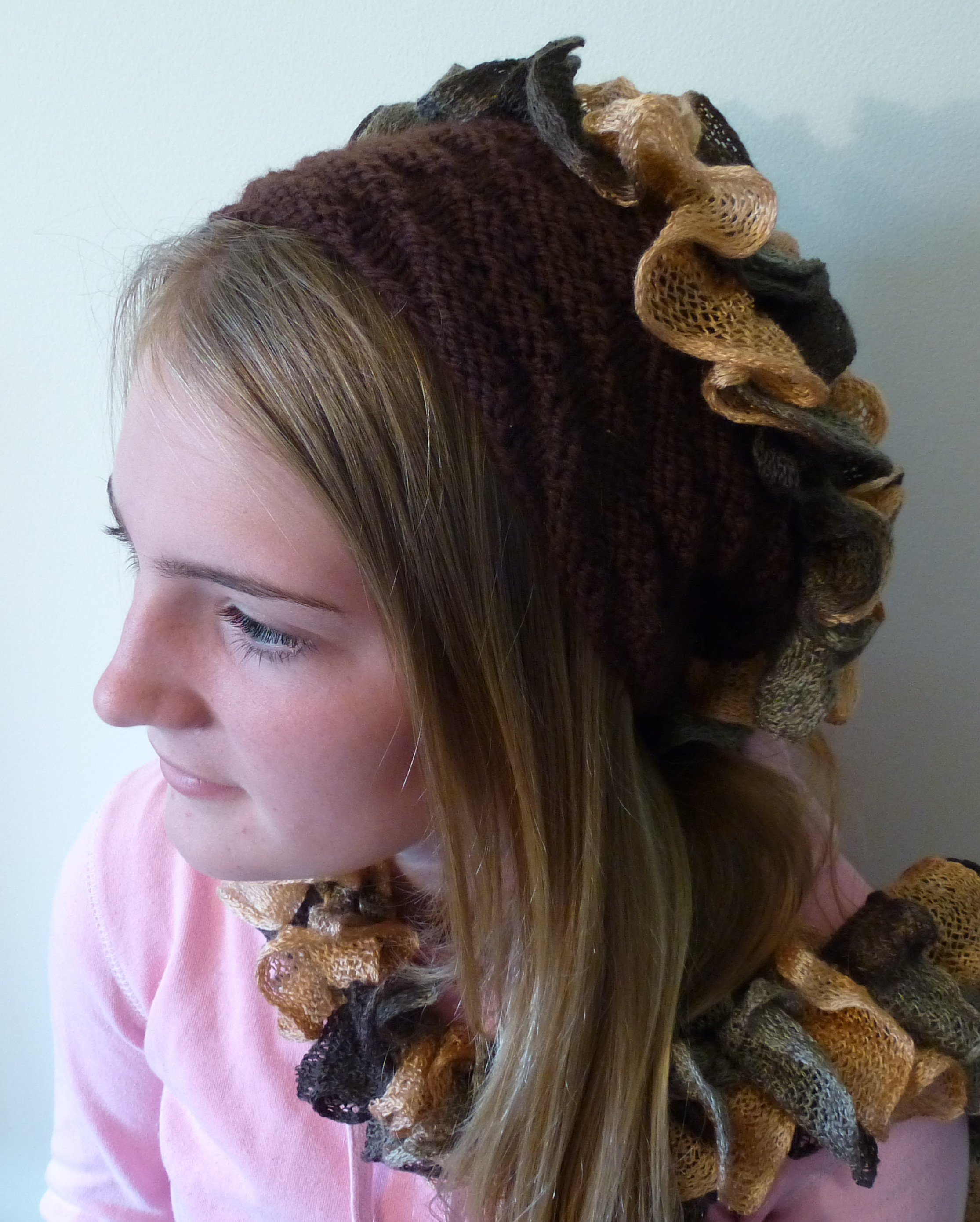
Here are two more hats I made with Bernat Twist and Twirl.  My mum saw me making the other hats.  She thought this meant I really liked the yarn, so she bought me two more balls…gee, thanks mum.  I made these hats then I made a scarf to use up the rest and wear with the hats.  The nice part…hardly any frills! …lol

Sarah in the other hat

Sarah in the other hat

Flags

Meg had the right t-shirt to go with this one...

Meg had the right t-shirt to go with this one…

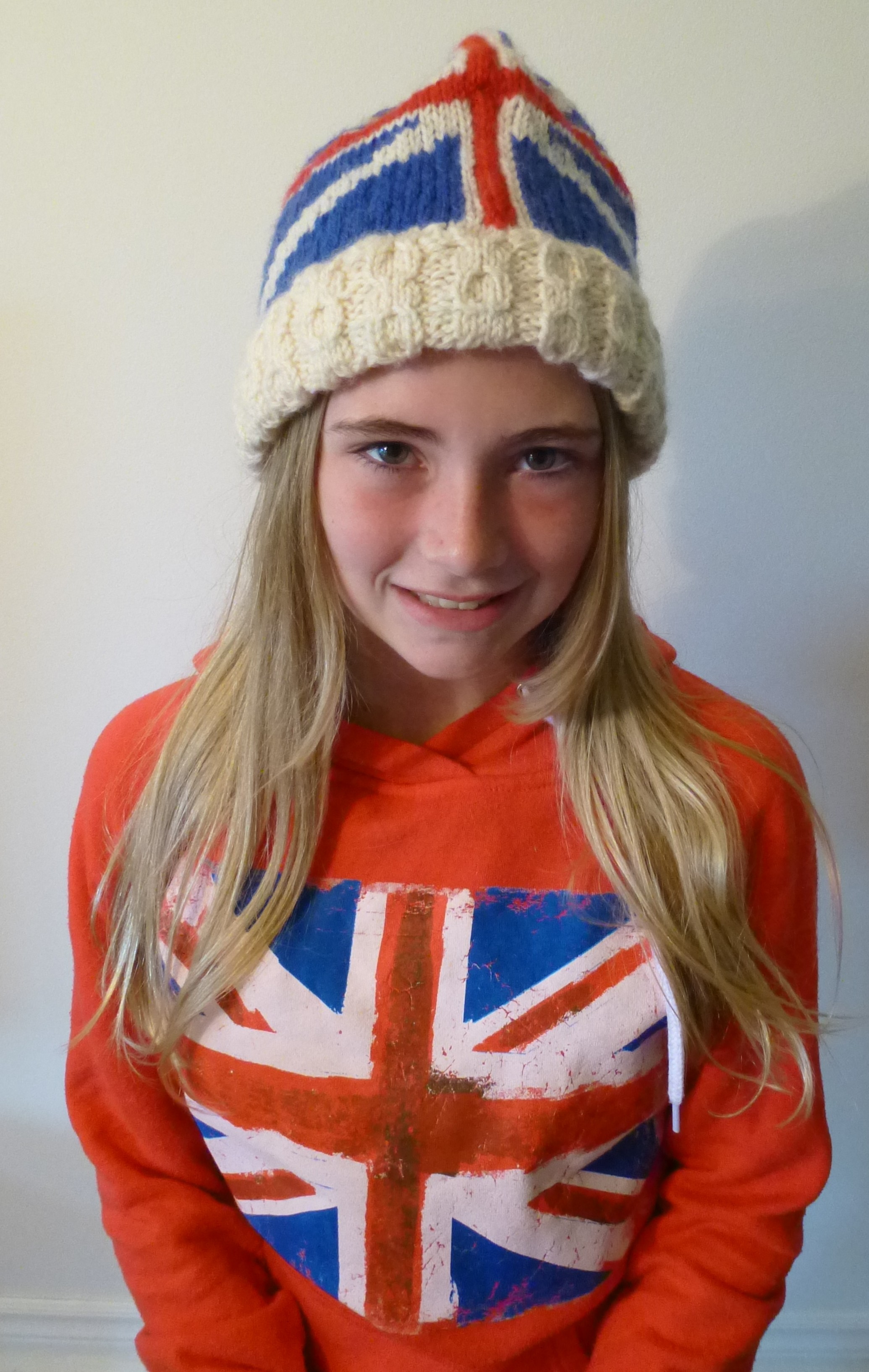
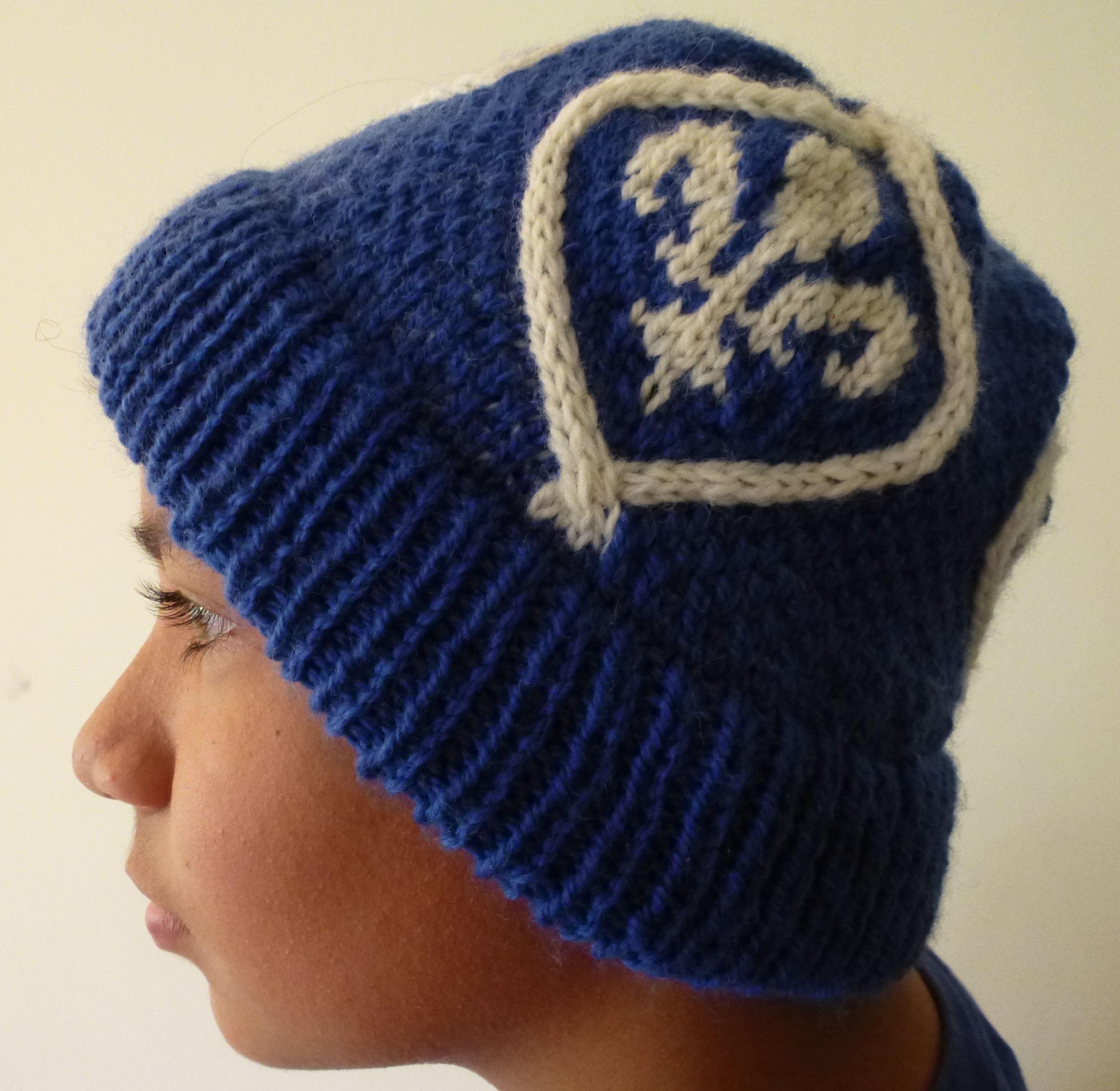
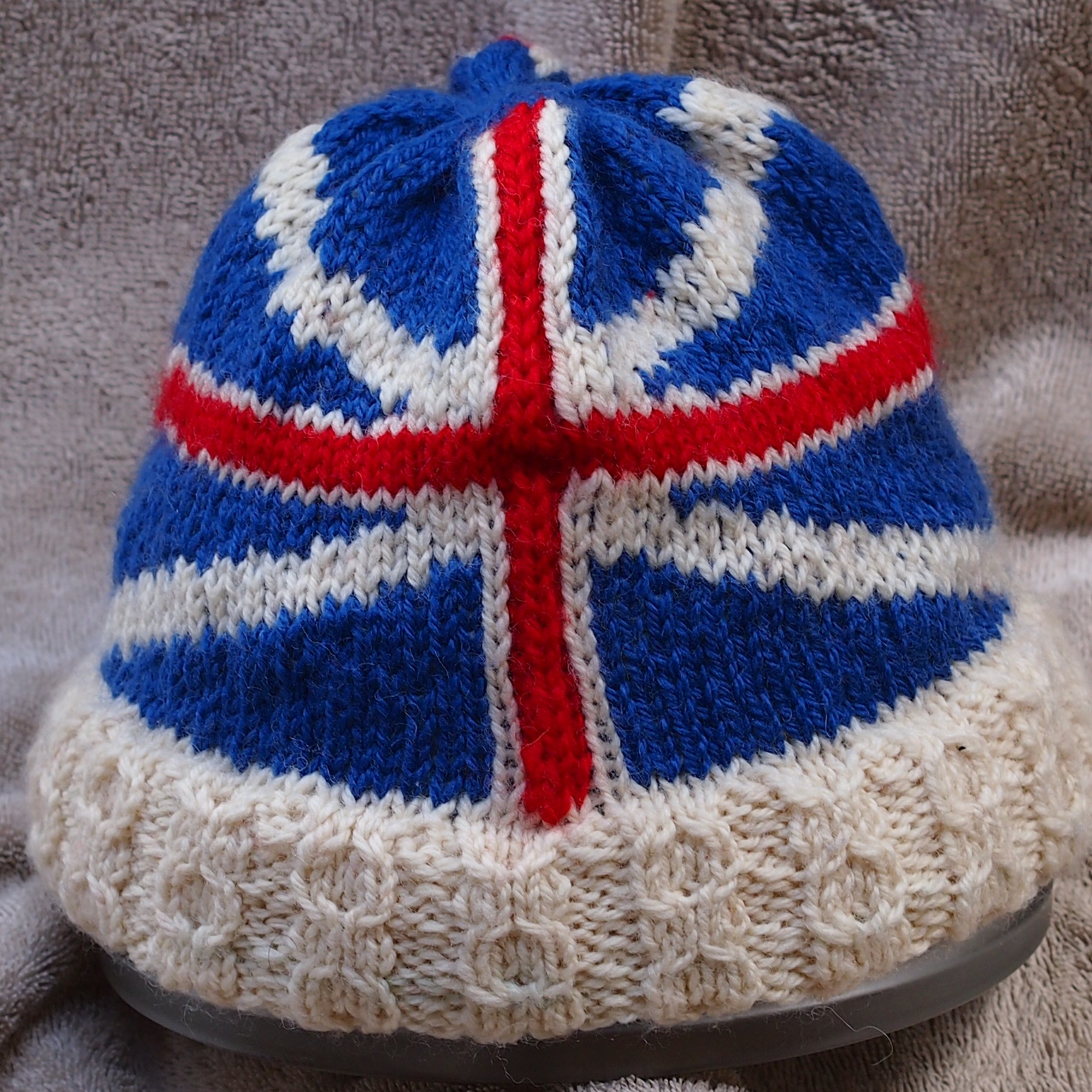
I had a very short-lived phase where I was going to do flags.  I did the Union Jack first.  I then did the Quebec fleur-de-lis.  I had big plans to go on to other ones, but I got sidetracked after these two.

Jay with the fleur-de-lis

Jay with the fleur-de-lis

OLYMPUS DIGITAL CAMERA

Just the hat…union jack

Here comes Peter Cottontail

Sarah in a fluffball hat

Sarah in a Bunny Tails hat

This yarn is called Bunny tails by Loops and Threads.  I couldn’t resist its weirdness…and it was on supersale … it may be discontinued…go figure!  This is the best I could do with it and I couldn’t really think of anything else to try. I remember that I did try putting them closer together, but it didn’t look any good either so I ripped it out to get my normal yarn back.   I used virtually none of the ball, so I have lots left  if I ever want to try again.  These novelty yarns often go on for hat after hat.  I remember a spinning instructor saying “really good knitting can sometimes hide really bad spinning”.  I think that bad hats can sometimes appear not so bad with a good model like my niece Sarah.

No frills allowed

Heather in another unwearable hat

Heather in another unwearable hat

Heather seems scared… it has been more than a week since I have produced, in her opinion, a wearable hat…she came down this morning and saw this hat which I started last night,,,the third one with frills in a row.   She said “could you stop with the frills…they are awful” (don’t hold back honey, tell me what you really think). She also had a very valid point that this hat needs more peaches and less cream.   I guess we will call the frill experiment over and I will go onto something else for a while.

back view

back view

Frilly bottoms

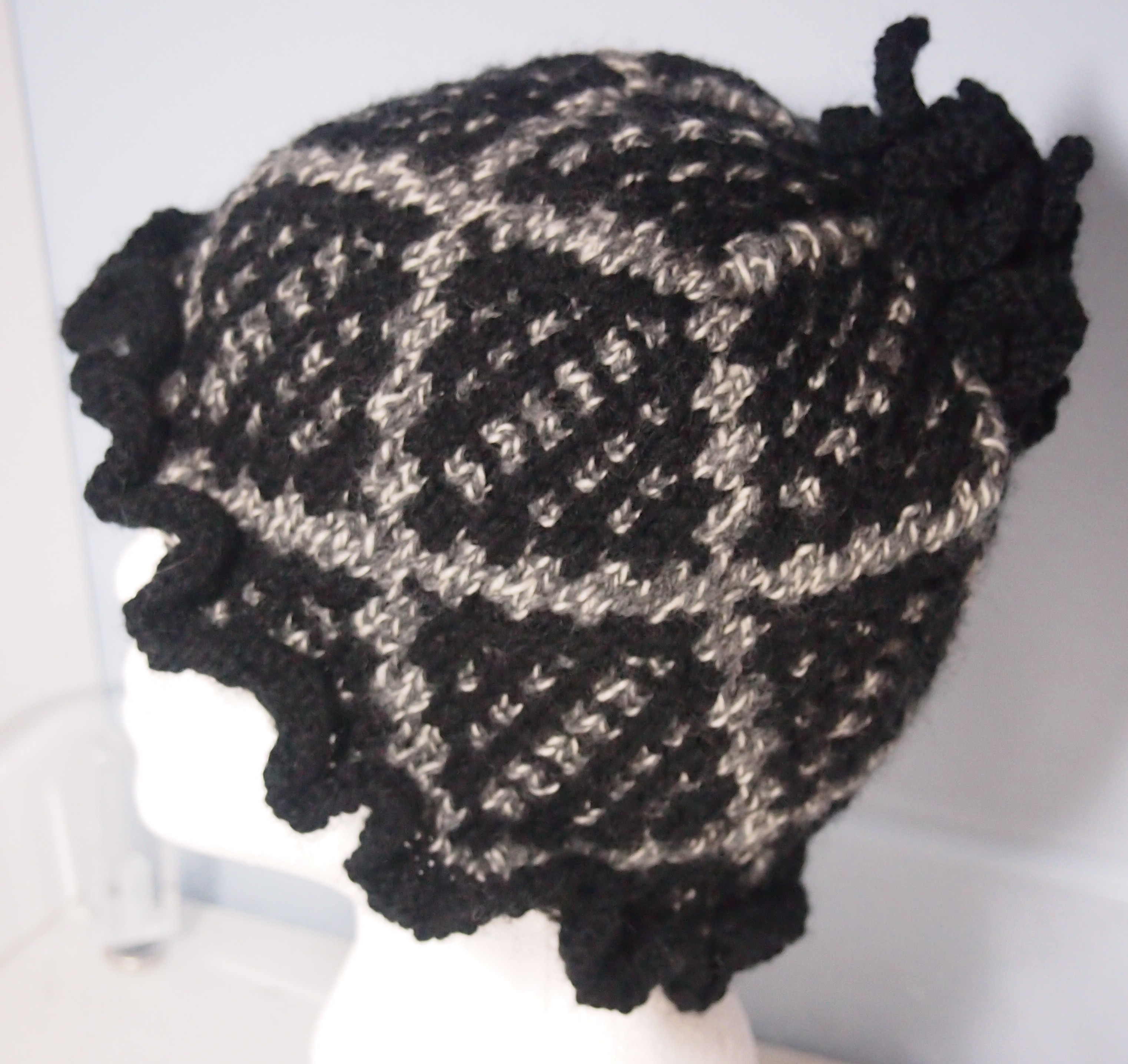
frilly bottom

frilly bottom

When I was doing the Remembrance Day hat, i did a scalloped bottom on the unfelted version.  I kind of liked how that worked out, so I decided I would explore the frilled edge for a few hats.  I made this one this weekend with Patons Classic Wool, black and Light Grey Marl.  I don’t think this hat works particularly well, but I think variations on the frilly bottom may an interesting avenue to pursue for a hat or two.

Men with hats…

grey and white...always OK

grey and white…usually OK for men

I don’t know if it is just me, but I think that there are many more possibilities when designing hats for women.  Women can get away with any kind of colour or any amount of frilliness they want, although it still takes a certain personality to pull some more outlandish things off.  I can see most of the hats I make being worn by women, but a small subset can also be worn by men.  When I look at the hats around me (which of course I do constantly), I think most men tend to wear simple watch caps or ski hats.  Of my hats, more of the ones that men might wear are either off white, dark colours or shades of grey.

Unless you are my wonderful nephew Ben, for whom everything in life has always been possible.

everything is possible

anything and everything is possible

Elegant fireworks…entrelac edition

elegant fireworks..entrelac

elegant fireworks..entrelac

This is the second of at least three hats I will make with the three eyelash balls of yarn.  The first one  can be seen in my first Elegant Fireworks post.

Entrelac often involves very short rows.  On this hat the rows were only four stitches long. This would involve turning your work every 4 stitches all around the brim…  I knew I couldn’t both put off figuring out backwards knitting AND keep my sanity if I was going to do this.  I looked it up in A Gathering of Lace and on Youtube, then I forced myself to do it.  Backwards knitting  will be good to know for turning heels too.

put left needle into back of stitch on right needle and wrap wool from top to bottom

put left needle into back of stitch on right needle and wrap wool from top to bottom

finiah stitch by pulling loop forward and off

finish stitch by pulling loop forward and off

To knit backwards, you put the left needle into the back of the stitch on your right hand needle, then wrap your yarn from top to bottom and knit it off.  I have it down pat now, and I am pretty sure it will be in my wheelhouse from now on.

One thing I learned is that you have to hold the yarn in your right hand, or else it is impossible to make the stitch correctly.  You have to wrap the yarn from top to bottom, and this can’t be done with the left hand at this angle.  If right handed yarn holding is not in the cards, it is not actually such a big deal, you just have to knit into the back to turn your stitches as you knit them forwards again.

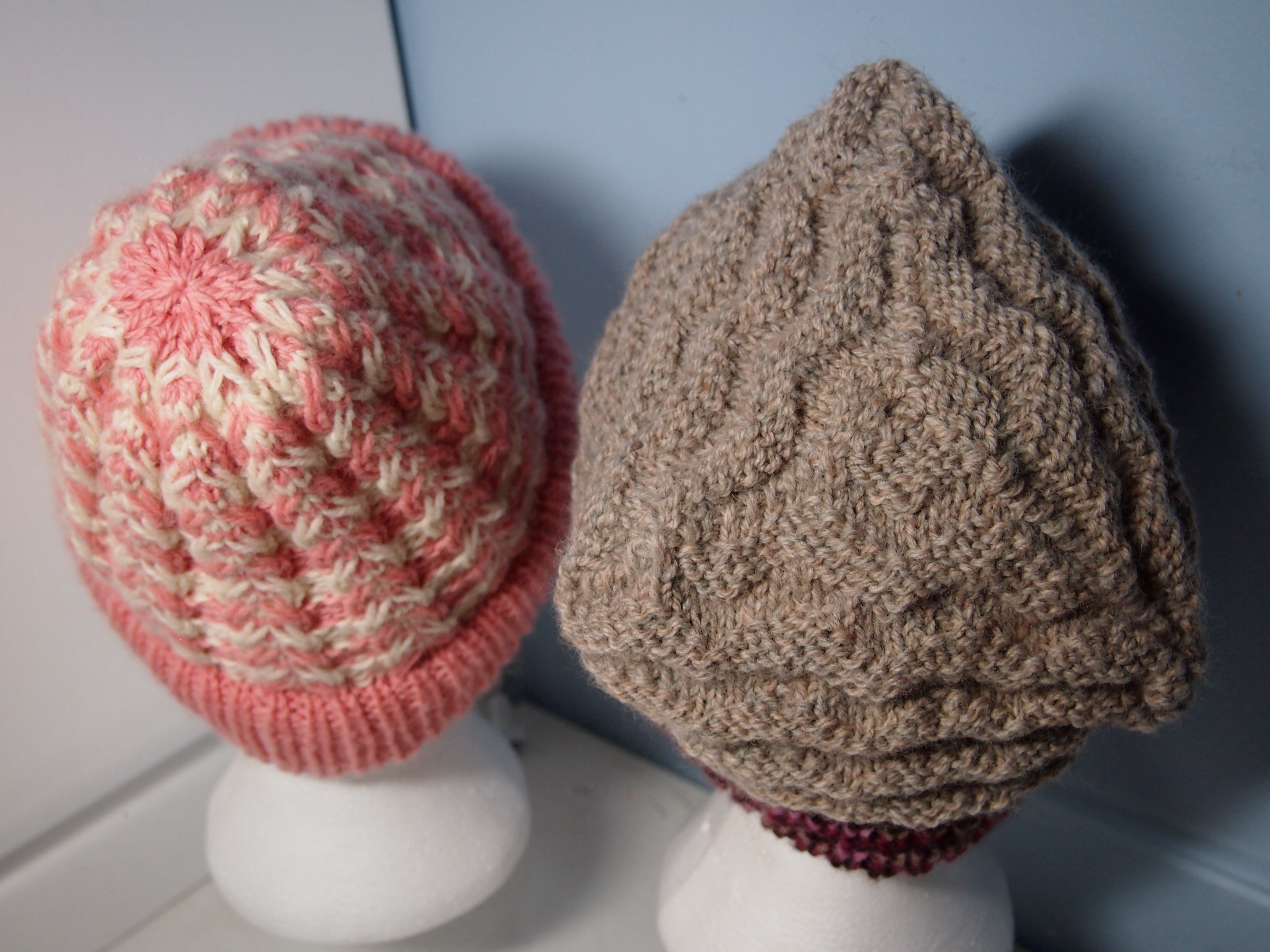
Roll up the rim to win! Winter’s coming to the Great White North

How many Canadian cliches can I get into one post title, eh?  But this is a topic that is almost as dear to my heart as coffee itself…okay I’m done…

Although I make hats pretty much constantly, I often forget to wear them.  People that know me well, know that I am pretty impervious to external temperature (the hot flashes I had a while ago notwithstanding).  For this reason, I often don’t wear what I should in the winter.  Last year, I was commuting to downtown Ottawa and had to pass a bit of a wind tunnel on my walk to the transitway to catch my bus.  One day as I was holding my mittenless hands up to my frozen forehead, I realized how important the covering of the forehead and ears truly are at about 15 below and colder.  Having said that, I have never much cared for the folded up brim on a knitted hat.  They often go skew-whiff as my mother would say, especially if you change colour or pattern after the ribbing and want the fold to be exactly consistent.

These are two variations on the rolled brim that I use all the time.  I suppose that you could sew the brim up, but I consider the sewing up needle my mortal enemy and usually avoid seams at any cost.  I have also found that you have to be careful with tension when you try to sew up the rim or you can easily end up with it being too tight.  Knitting the seam together solves these problems.  I worked up two hat designs this week to demonstrate the process.

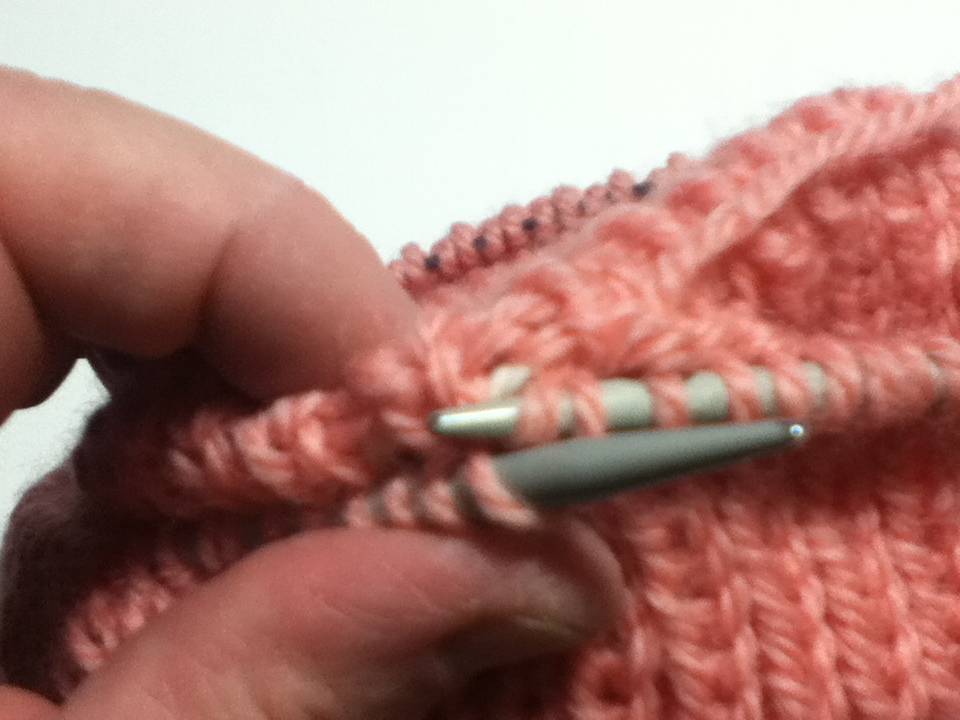
put needle in live stitch AND the corresponding stitch on the cast on edge, then knit them together

put needle in live stitch AND the corresponding stitch on the cast on edge, then knit them together

If you just want a normally warm hat, go with the single roll. For this, you will need to make your ribbing twice as high as you want it to finish at.

Fold up the cast on edge inside your knitting, and hold it so the stitches on the cast on edge match up with the same stitches on your needle.  If you are doing a regular k1 p1 rib, remember that what is a knit stitch on the front will present as a purl stitch on the rolled up cast on edge behind your work.  Put your needle into the stitch on your needle, then into the front loop of the cast on edge.  Wrap your wool and knit them off together.  This will give you a nice double thickness over your ears and forehead.

run a guide thread 1/3 of way up the ribbing

run a guide thread 1/3 of way up the ribbing

roll over twice to the inside

roll over twice to the inside

For the second (warmer) variation, you will end up with a triple thickness of ribbing.   You will need to do about 7″ of ribbing if you want it to cover your ears.  You can do less if you want a narrower brim.

I have found it helpful to run a guide thread just below where you will connect into your work.  I tried it without the guide thread, but it is too easy to connect one stitch too high or low randomly.    Run the guide thread through all the stitches around the hat in the row that is 1/3 of the way up the ribbing.

Roll the brim up twice inside your work so the first fold is behind the working needle, inside the knitting.

knit into live stitch AND into stitch on fold just below the  guide thread and knit them together

knit into live stitch AND into stitch on fold just below the guide thread and knit them together

Put the needle into the live stitch then pick up the corresponding stitch off the fold, immediately below the guide thread.  In this case you will be picking up a knit stitch off the brim with a knit stitch off the live needle.  This is because in the single rolled brim (above), you are picking up into the back of the ribbing, whereas for the triple thickness, you are picking up into the front of the ribbing.

.

.

.

.

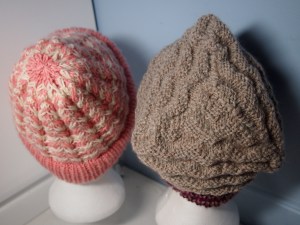
rolled rim hats...from the front

rolled rim hats…from the front

rolled rim hats...from the back

rolled rim hats…from the back

Here are the finished hats: