Tag Archives: Patons Classic Wool

Roll up the rim to win! Winter’s coming to the Great White North

How many Canadian cliches can I get into one post title, eh?  But this is a topic that is almost as dear to my heart as coffee itself…okay I’m done…

Although I make hats pretty much constantly, I often forget to wear them.  People that know me well, know that I am pretty impervious to external temperature (the hot flashes I had a while ago notwithstanding).  For this reason, I often don’t wear what I should in the winter.  Last year, I was commuting to downtown Ottawa and had to pass a bit of a wind tunnel on my walk to the transitway to catch my bus.  One day as I was holding my mittenless hands up to my frozen forehead, I realized how important the covering of the forehead and ears truly are at about 15 below and colder.  Having said that, I have never much cared for the folded up brim on a knitted hat.  They often go skew-whiff as my mother would say, especially if you change colour or pattern after the ribbing and want the fold to be exactly consistent.

These are two variations on the rolled brim that I use all the time.  I suppose that you could sew the brim up, but I consider the sewing up needle my mortal enemy and usually avoid seams at any cost.  I have also found that you have to be careful with tension when you try to sew up the rim or you can easily end up with it being too tight.  Knitting the seam together solves these problems.  I worked up two hat designs this week to demonstrate the process.

put needle in live stitch AND the corresponding stitch on the cast on edge, then knit them together

put needle in live stitch AND the corresponding stitch on the cast on edge, then knit them together

If you just want a normally warm hat, go with the single roll. For this, you will need to make your ribbing twice as high as you want it to finish at.

Fold up the cast on edge inside your knitting, and hold it so the stitches on the cast on edge match up with the same stitches on your needle.  If you are doing a regular k1 p1 rib, remember that what is a knit stitch on the front will present as a purl stitch on the rolled up cast on edge behind your work.  Put your needle into the stitch on your needle, then into the front loop of the cast on edge.  Wrap your wool and knit them off together.  This will give you a nice double thickness over your ears and forehead.

run a guide thread 1/3 of way up the ribbing

run a guide thread 1/3 of way up the ribbing

roll over twice to the inside

roll over twice to the inside

For the second (warmer) variation, you will end up with a triple thickness of ribbing.   You will need to do about 7″ of ribbing if you want it to cover your ears.  You can do less if you want a narrower brim.

I have found it helpful to run a guide thread just below where you will connect into your work.  I tried it without the guide thread, but it is too easy to connect one stitch too high or low randomly.    Run the guide thread through all the stitches around the hat in the row that is 1/3 of the way up the ribbing.

Roll the brim up twice inside your work so the first fold is behind the working needle, inside the knitting.
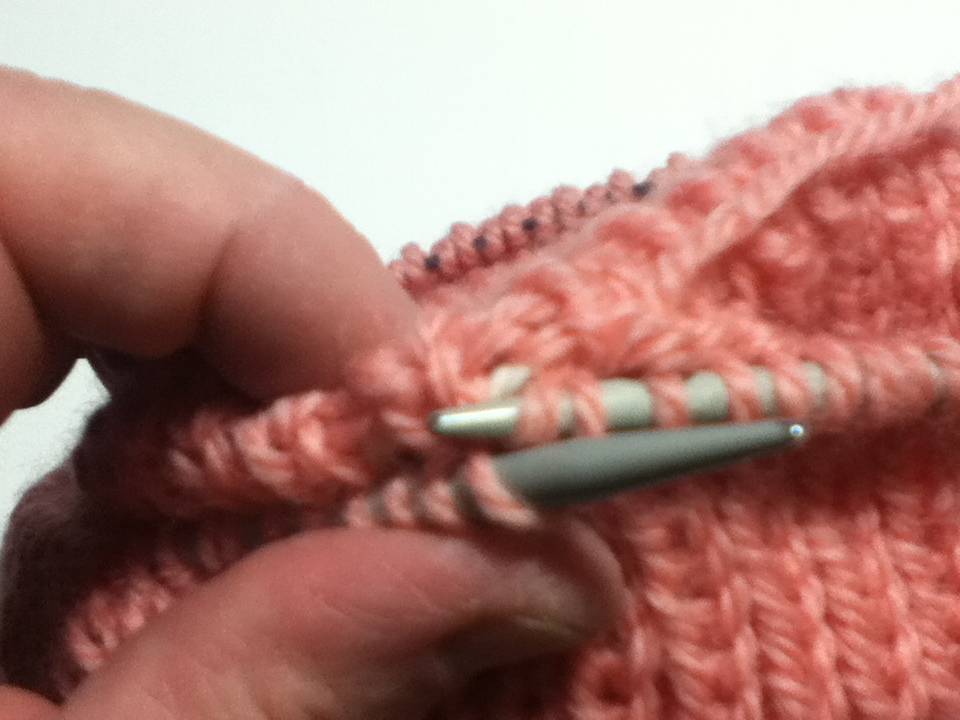
knit into live stitch AND into stitch on fold just below the  guide thread and knit them together

knit into live stitch AND into stitch on fold just below the guide thread and knit them together

Put the needle into the live stitch then pick up the corresponding stitch off the fold, immediately below the guide thread.  In this case you will be picking up a knit stitch off the brim with a knit stitch off the live needle.  This is because in the single rolled brim (above), you are picking up into the back of the ribbing, whereas for the triple thickness, you are picking up into the front of the ribbing.

.

.

.

.

rolled rim hats...from the front

rolled rim hats…from the front

rolled rim hats...from the back

rolled rim hats…from the back

Here are the finished hats:

Cables in the Dark

cables in the dark

cables in the dark

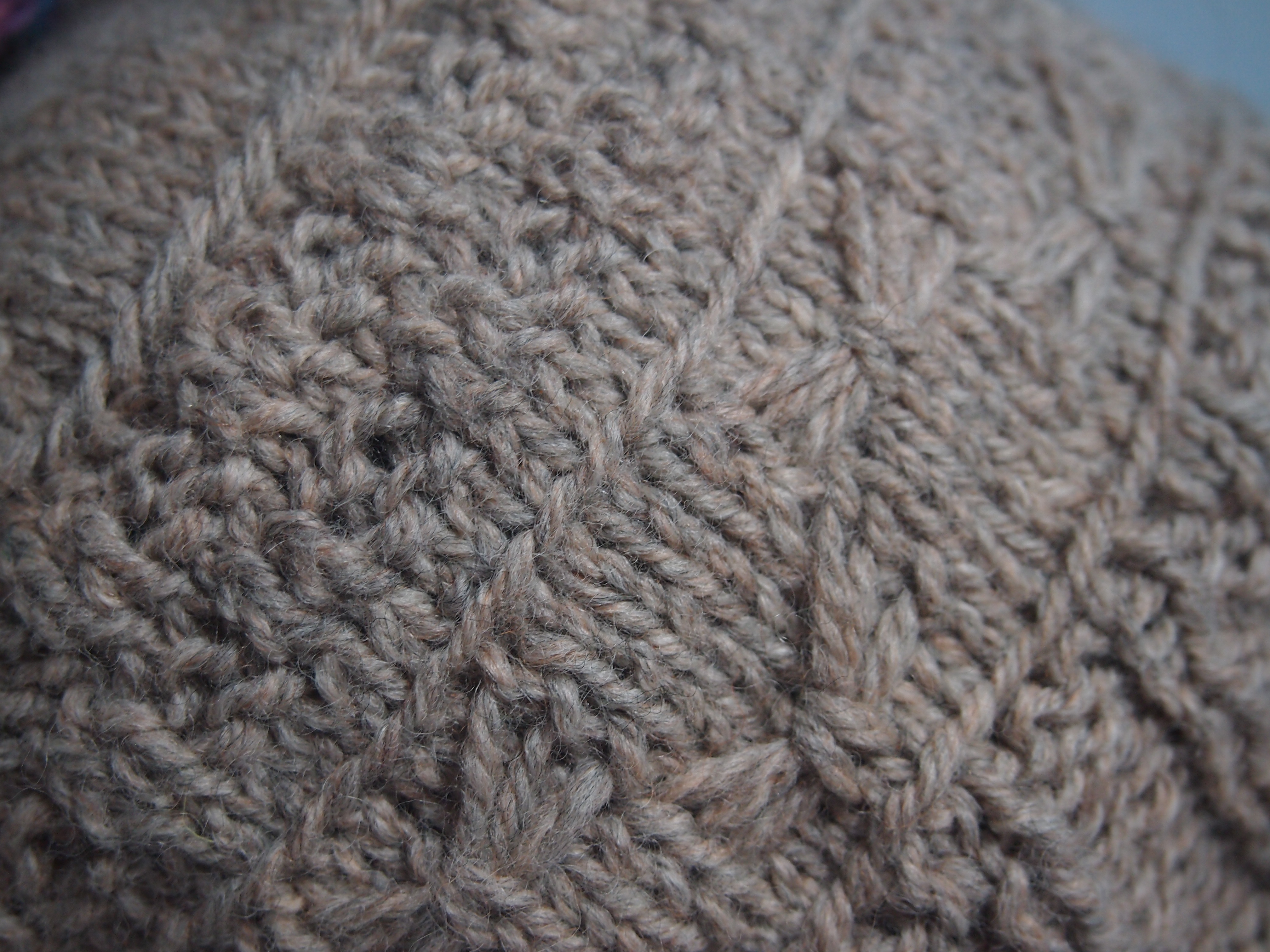
Sometimes, for me, knitting seems to be a biological imperative.  A while ago, we were driving to Toronto and it started to get dark.  The only knitting I had was this hat, and I really wanted to keep knitting.  I decided that I would keep going and if I screwed it up, I could rip it out when we got there and there was light.  I was amazed that I could actually tell when the cables were ready and that I could still manipulate the stitches on a dark highway in the middle of nowhere.  It turned out that when we got there, it was all OK and I only had to do the decreasing and the topper.  Granted, they are pretty simple cables.

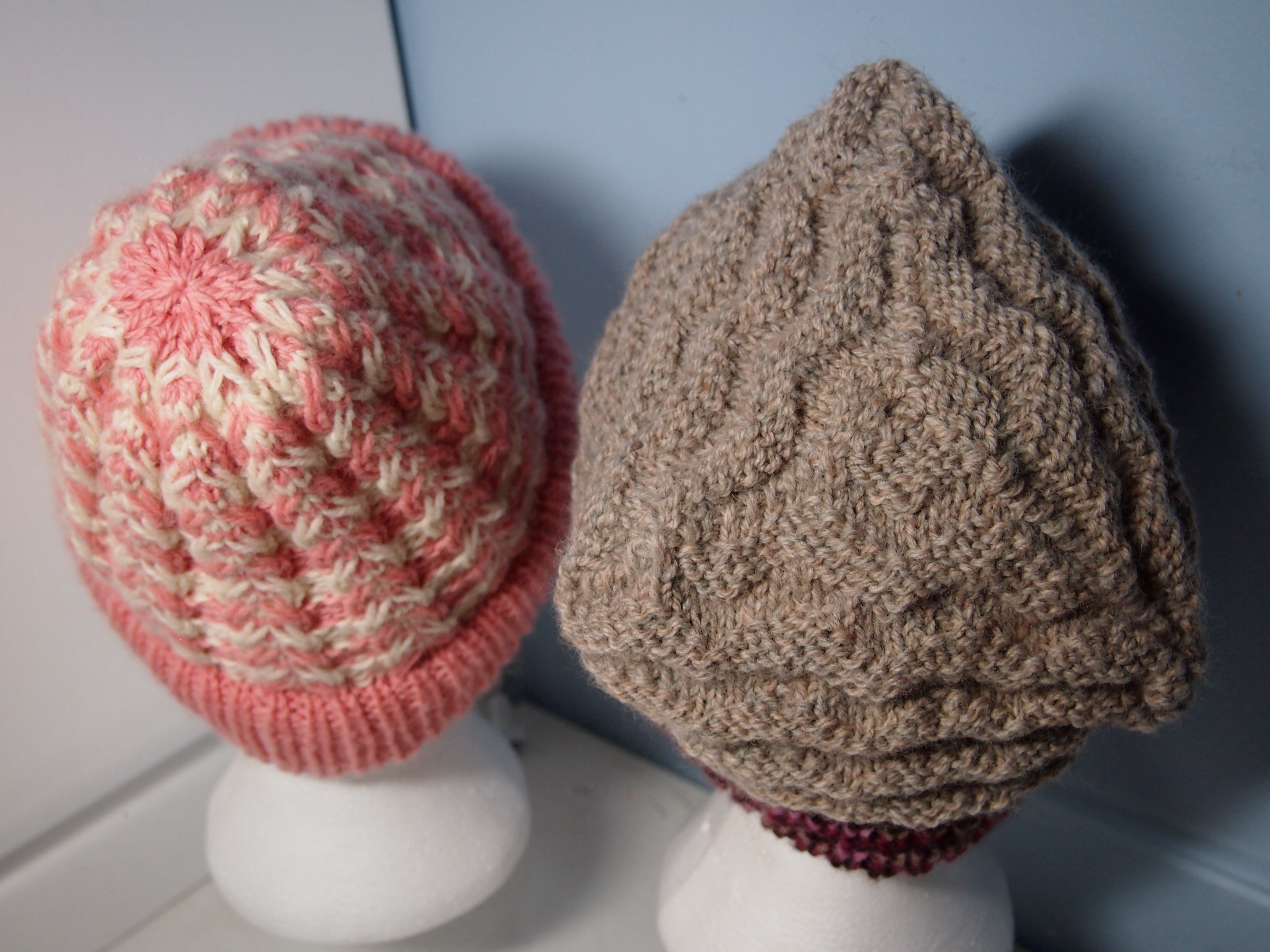
I was again playing with how the colours come out from the variegated yarn.  This is another colourway in Patons Classic Wool.  In this hat, instead of separating out like they did in the hats in the  Playing with Variegated Yarn post, they overlap in swirls  According to my notes, I cast on 10 fewer stitches for this hat (100 stitches) than the ones where the colours separated.

less stitches (too few) makes wider swirls of colour

less stitches (too few) makes wider swirls of colour

I tried this other hat with yet fewer stitches (96..so more overlap), but it is getting small for an adult.  You can see it was too small for the bowl we had used to display all the other hats.  It would be fine for kids though. You really are limited in how many stitches a) will work for your hat and b) will give you the effect you want.

I was trying to branch out a bit on the topper, so I used an idea which I modified from (I think) Knitting on the Edge, but I can’t find my copy to double check. It makes spirals.  I started the topper when I had decreased to 21 stitches. I started with the first three live stitches, did a slip 1, k2tog, psso, then cast on another 11.  I then knit all 12 back to the base and then, on the next row out,  I did a k1, p1, k1 in each stitch.  Finally, I cast off as I returned back to the base.  I went down to 1 stitch at the base, picked up two more live stitches did the s1, k2tog, psso and cast on another 11, etc.  I kept doing this, picking up stitches until I ran out of live stitches (10 swirls). The whole thing was corralled to make it hang together in a similar manner to the i-cord rose. I find you may have to play with the arms so the spirals will straighten up and fly right…oops I mean curl up and lie right.

Variations on a theme…Aran knit hat


Heather read my blog the other day and said that I was probably giving the impression that most of my hats are weird and made out of novelty yarn.  That is why I finished the top down hat for yesterday and I have decided to show a series of Aran hats today.  I worked on these back when I had aspirations to writing a hat design book,  The challenge I gave myself in this exercise was to make up a basic Aran pattern for a hat, then change the appearance of the hat by making different brims and tops.  These are what I came up with, 6 worsted weight hats and one hatband out of Patons Classic Wool, and a stripped down chunky wool version (can’t remember what it was)–okay, I admit, some of them may be weird.

Top down hat

top down hat

top down hat

top down hat...detail

top down hat…detail

I made just the top of this hat a couple of weeks ago so I could demonstrate the i-cord rose that I like to use (see Technique: I-cord rose (aka go big or go home)).  I only had the crown of the hat, so I picked up from the original cast on and built the hat downwards from there.  Unfortunately, I had only a few feet of yarn left of the variegated I had made the rose with…not even enough for one row more so I couldn’t reintroduce it further down for balance.  I think it is ok anyway.

In order to keep things consistent, I cast everything off and picked up all the stitches again twice further down the hat, once at each place I changed patterns.  I used Patons Classic Wool, yet again.  I always use a 4 1/2 mm needle with this yarn,  For the cast off, I wanted it loose to match the tension on the cast on edge near the crown, so I went up to a 7 mm just for the middle cast off.  Looking at this line,  I thought it could be even looser, so for the final cast off, closest to the ribbing, I used an 8 mm needle. I think I will go with 8 mm in future if I do this again.

Happy Halloween

Heather's Jack-o-lantern

Heather’s Jack-o-lantern

Alan and Heather got the last pumpkin in the store yesterday.  It was a huge pumpkin for $3.99, but it was a bit moldy inside….can’t have everything and the Jack-o-lantern only has to last a couple of hours anyway.   Heather carved it a dusk and I think it looks great.

A while ago I was saying to Heather that I would like to do a Santa hat nearer to Christmas.  I got ‘MUM, Santa hats are NOT knitted, you might as well make a witches hat too!’.  Of course, this made the idea of a felted witches hat pop into my head.

...before felting

…before felting

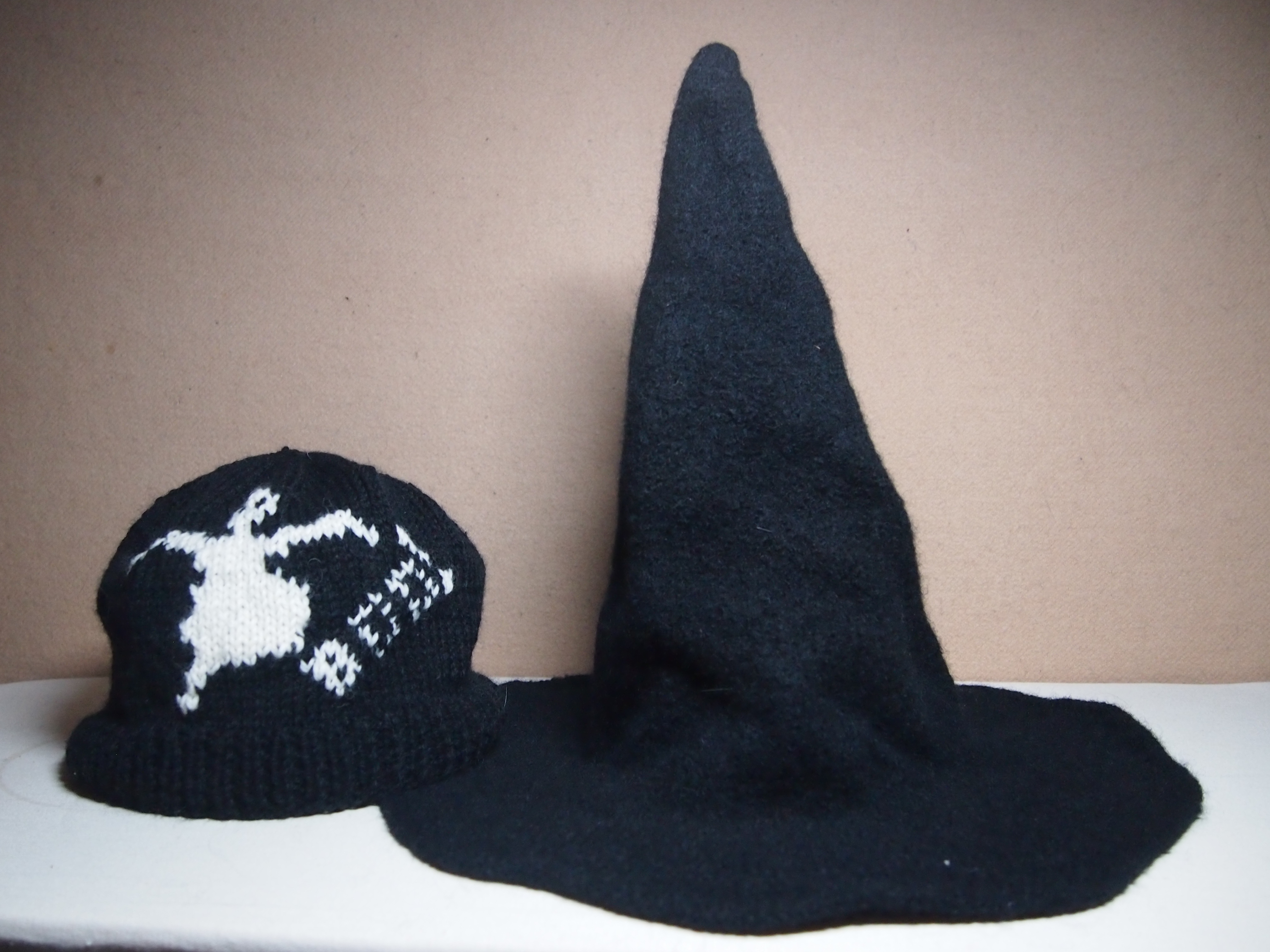
I was making the witches hat till the last minute.  It still needs some work to make the brim stay up, and I will decorate it a bit more.  It is, however sort of the right size and shape, so that part is good.  The washing machine ate my tension square.  I made one.  Honest. We looked all through the laundry last weekend and it had disappeared without a trace.  I looked up what people said the shrinkage was for Patons Classic Wool then did the math and went for it.  Here are the before and after pictures.  Included in the picture is another hat that Heather calls ‘Penquin in a Hoop Skirt’.  I should have followed my own advice and ripped it out when I noticed I had put and extra stitch in the ghost’s belly, but the intarsia was causing me grief and I didn’t want to redo it.

Penquin in a Hoop Skirt and the Witches hat

Penquin in a Hoop Skirt and the Witches hat

So, to sum up, a bare pass and an epic fail….