Monthly Archives: November 2013

Men with hats…

grey and white...always OK

grey and white…usually OK for men

I don’t know if it is just me, but I think that there are many more possibilities when designing hats for women.  Women can get away with any kind of colour or any amount of frilliness they want, although it still takes a certain personality to pull some more outlandish things off.  I can see most of the hats I make being worn by women, but a small subset can also be worn by men.  When I look at the hats around me (which of course I do constantly), I think most men tend to wear simple watch caps or ski hats.  Of my hats, more of the ones that men might wear are either off white, dark colours or shades of grey.

Unless you are my wonderful nephew Ben, for whom everything in life has always been possible.

everything is possible

anything and everything is possible

Elegant fireworks…entrelac edition

elegant fireworks..entrelac

elegant fireworks..entrelac

This is the second of at least three hats I will make with the three eyelash balls of yarn.  The first one  can be seen in my first Elegant Fireworks post.

Entrelac often involves very short rows.  On this hat the rows were only four stitches long. This would involve turning your work every 4 stitches all around the brim…  I knew I couldn’t both put off figuring out backwards knitting AND keep my sanity if I was going to do this.  I looked it up in A Gathering of Lace and on Youtube, then I forced myself to do it.  Backwards knitting  will be good to know for turning heels too.

put left needle into back of stitch on right needle and wrap wool from top to bottom

put left needle into back of stitch on right needle and wrap wool from top to bottom

finiah stitch by pulling loop forward and off

finish stitch by pulling loop forward and off

To knit backwards, you put the left needle into the back of the stitch on your right hand needle, then wrap your yarn from top to bottom and knit it off.  I have it down pat now, and I am pretty sure it will be in my wheelhouse from now on.

One thing I learned is that you have to hold the yarn in your right hand, or else it is impossible to make the stitch correctly.  You have to wrap the yarn from top to bottom, and this can’t be done with the left hand at this angle.  If right handed yarn holding is not in the cards, it is not actually such a big deal, you just have to knit into the back to turn your stitches as you knit them forwards again.

Roll up the rim to win! Winter’s coming to the Great White North

How many Canadian cliches can I get into one post title, eh?  But this is a topic that is almost as dear to my heart as coffee itself…okay I’m done…

Although I make hats pretty much constantly, I often forget to wear them.  People that know me well, know that I am pretty impervious to external temperature (the hot flashes I had a while ago notwithstanding).  For this reason, I often don’t wear what I should in the winter.  Last year, I was commuting to downtown Ottawa and had to pass a bit of a wind tunnel on my walk to the transitway to catch my bus.  One day as I was holding my mittenless hands up to my frozen forehead, I realized how important the covering of the forehead and ears truly are at about 15 below and colder.  Having said that, I have never much cared for the folded up brim on a knitted hat.  They often go skew-whiff as my mother would say, especially if you change colour or pattern after the ribbing and want the fold to be exactly consistent.

These are two variations on the rolled brim that I use all the time.  I suppose that you could sew the brim up, but I consider the sewing up needle my mortal enemy and usually avoid seams at any cost.  I have also found that you have to be careful with tension when you try to sew up the rim or you can easily end up with it being too tight.  Knitting the seam together solves these problems.  I worked up two hat designs this week to demonstrate the process.

put needle in live stitch AND the corresponding stitch on the cast on edge, then knit them together

put needle in live stitch AND the corresponding stitch on the cast on edge, then knit them together

If you just want a normally warm hat, go with the single roll. For this, you will need to make your ribbing twice as high as you want it to finish at.

Fold up the cast on edge inside your knitting, and hold it so the stitches on the cast on edge match up with the same stitches on your needle.  If you are doing a regular k1 p1 rib, remember that what is a knit stitch on the front will present as a purl stitch on the rolled up cast on edge behind your work.  Put your needle into the stitch on your needle, then into the front loop of the cast on edge.  Wrap your wool and knit them off together.  This will give you a nice double thickness over your ears and forehead.

run a guide thread 1/3 of way up the ribbing

run a guide thread 1/3 of way up the ribbing

roll over twice to the inside

roll over twice to the inside

For the second (warmer) variation, you will end up with a triple thickness of ribbing.   You will need to do about 7″ of ribbing if you want it to cover your ears.  You can do less if you want a narrower brim.

I have found it helpful to run a guide thread just below where you will connect into your work.  I tried it without the guide thread, but it is too easy to connect one stitch too high or low randomly.    Run the guide thread through all the stitches around the hat in the row that is 1/3 of the way up the ribbing.

Roll the brim up twice inside your work so the first fold is behind the working needle, inside the knitting.

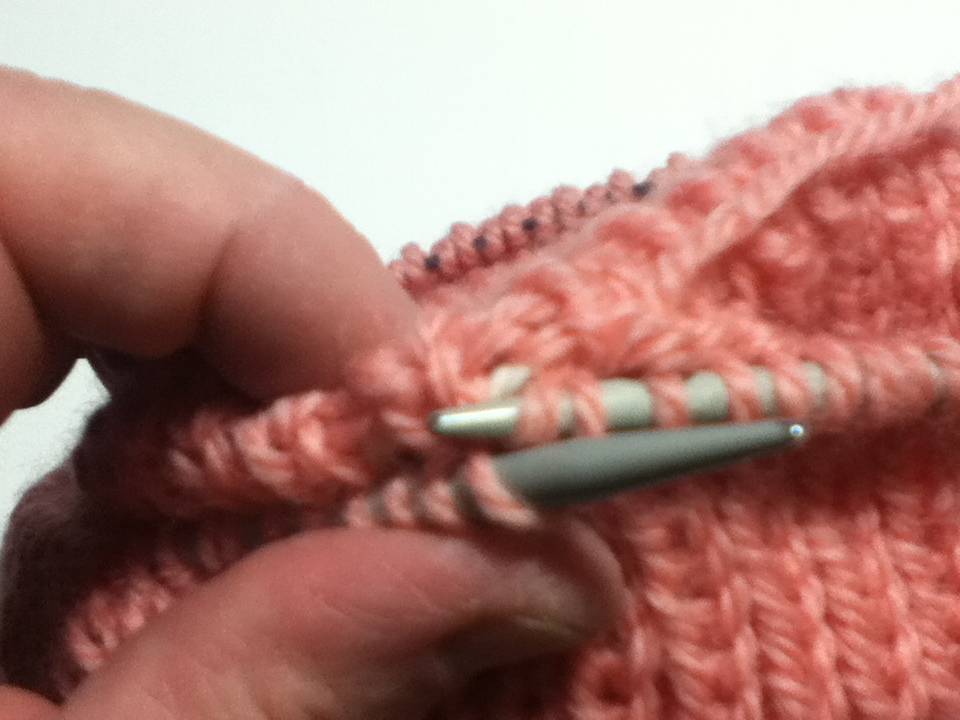
knit into live stitch AND into stitch on fold just below the  guide thread and knit them together

knit into live stitch AND into stitch on fold just below the guide thread and knit them together

Put the needle into the live stitch then pick up the corresponding stitch off the fold, immediately below the guide thread.  In this case you will be picking up a knit stitch off the brim with a knit stitch off the live needle.  This is because in the single rolled brim (above), you are picking up into the back of the ribbing, whereas for the triple thickness, you are picking up into the front of the ribbing.

.

.

.

.

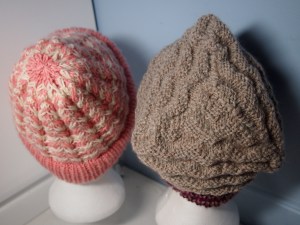
rolled rim hats...from the front

rolled rim hats…from the front

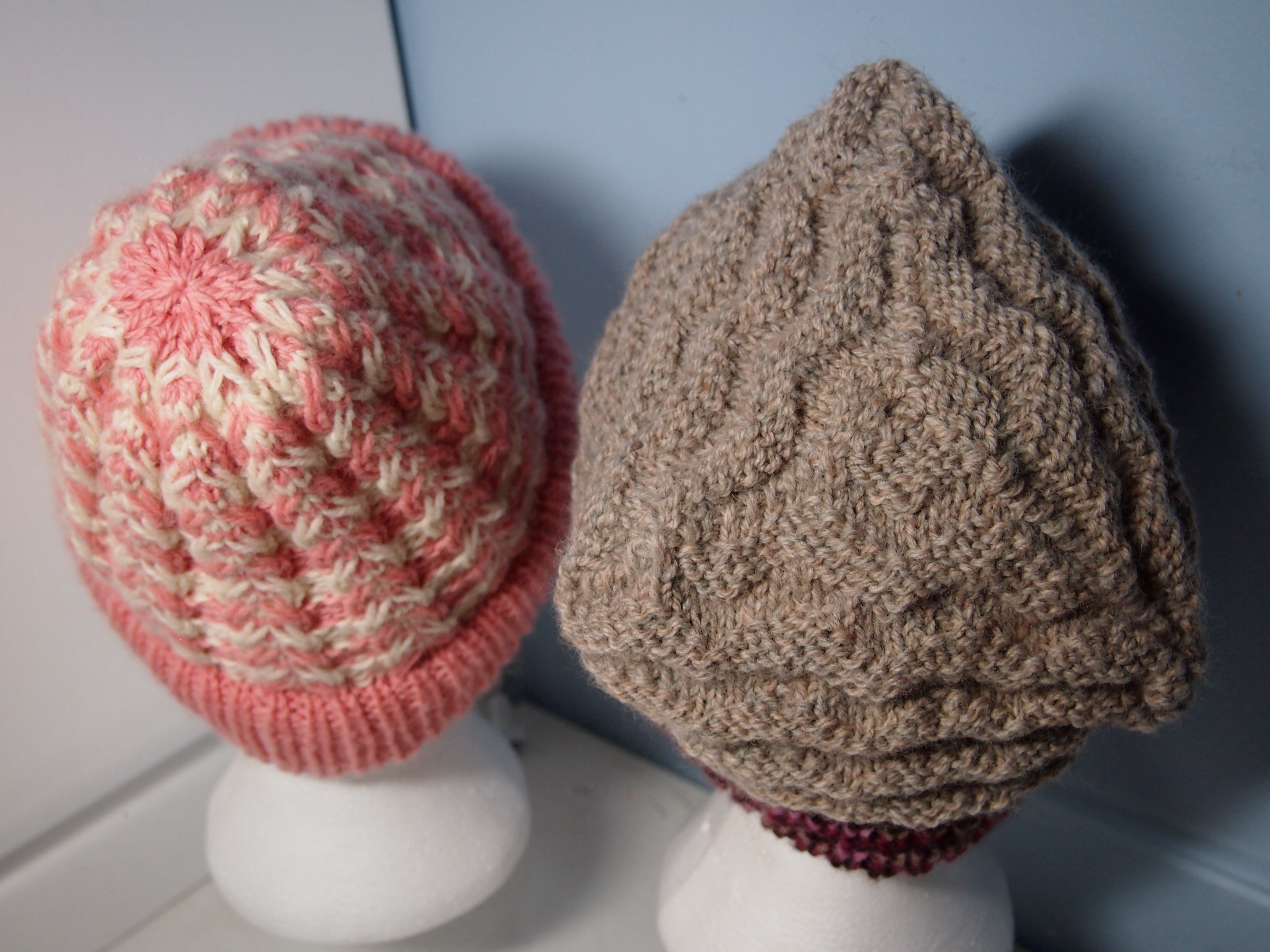
rolled rim hats...from the back

rolled rim hats…from the back

Here are the finished hats:

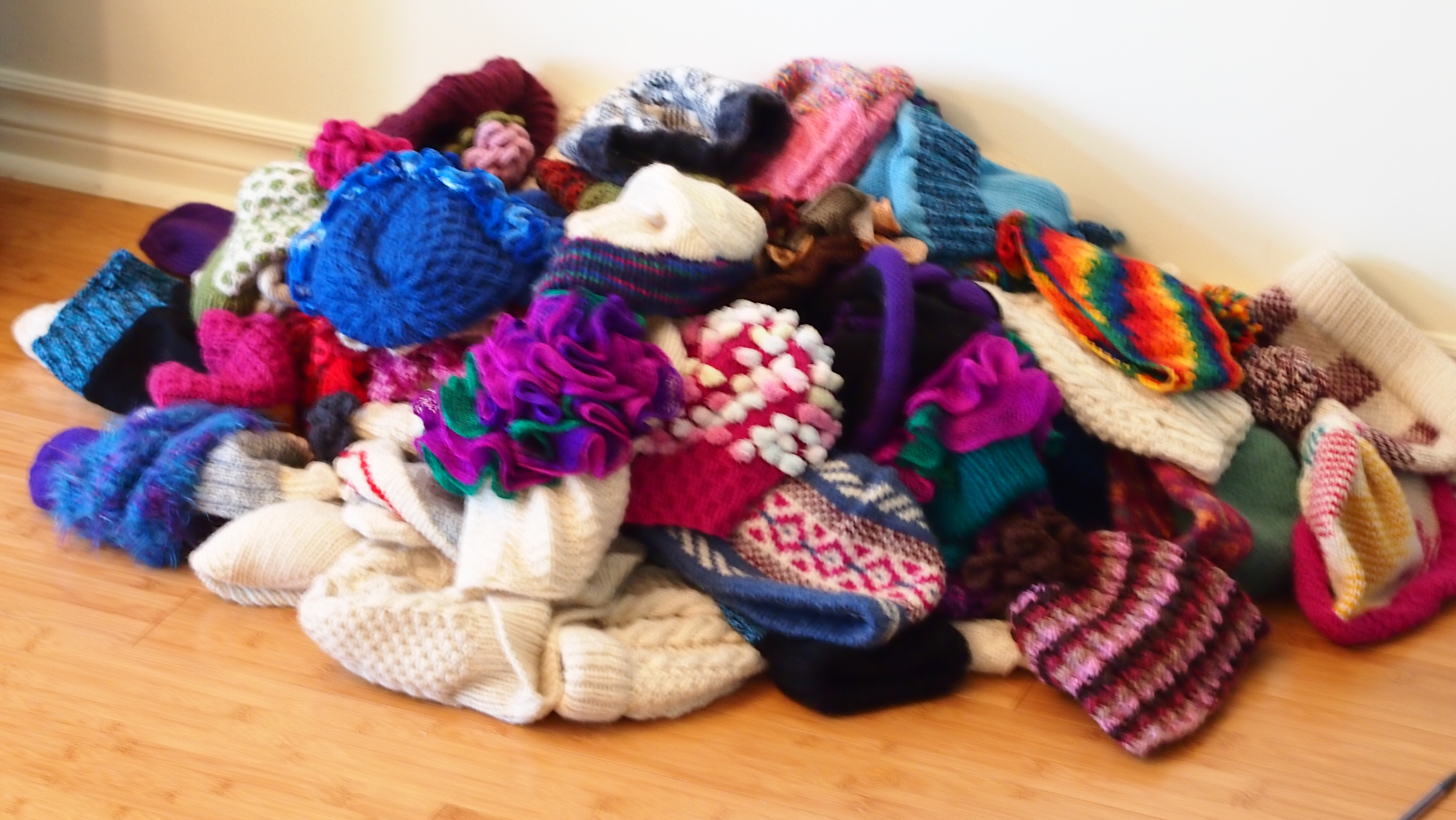
A pile of hats

pile of hats

pile of hats

My family met at my sister Jane’s for the August long weekend.  Another sister, Penny, told me to bring my accumulated hats for a photo shoot, so I could start this blog.  We also co-opted my brother in law, Will, who has a nice camera with a portrait lens.  We threw all the hats down together and ended up with a big pile of hats to deal with, so things got busy.

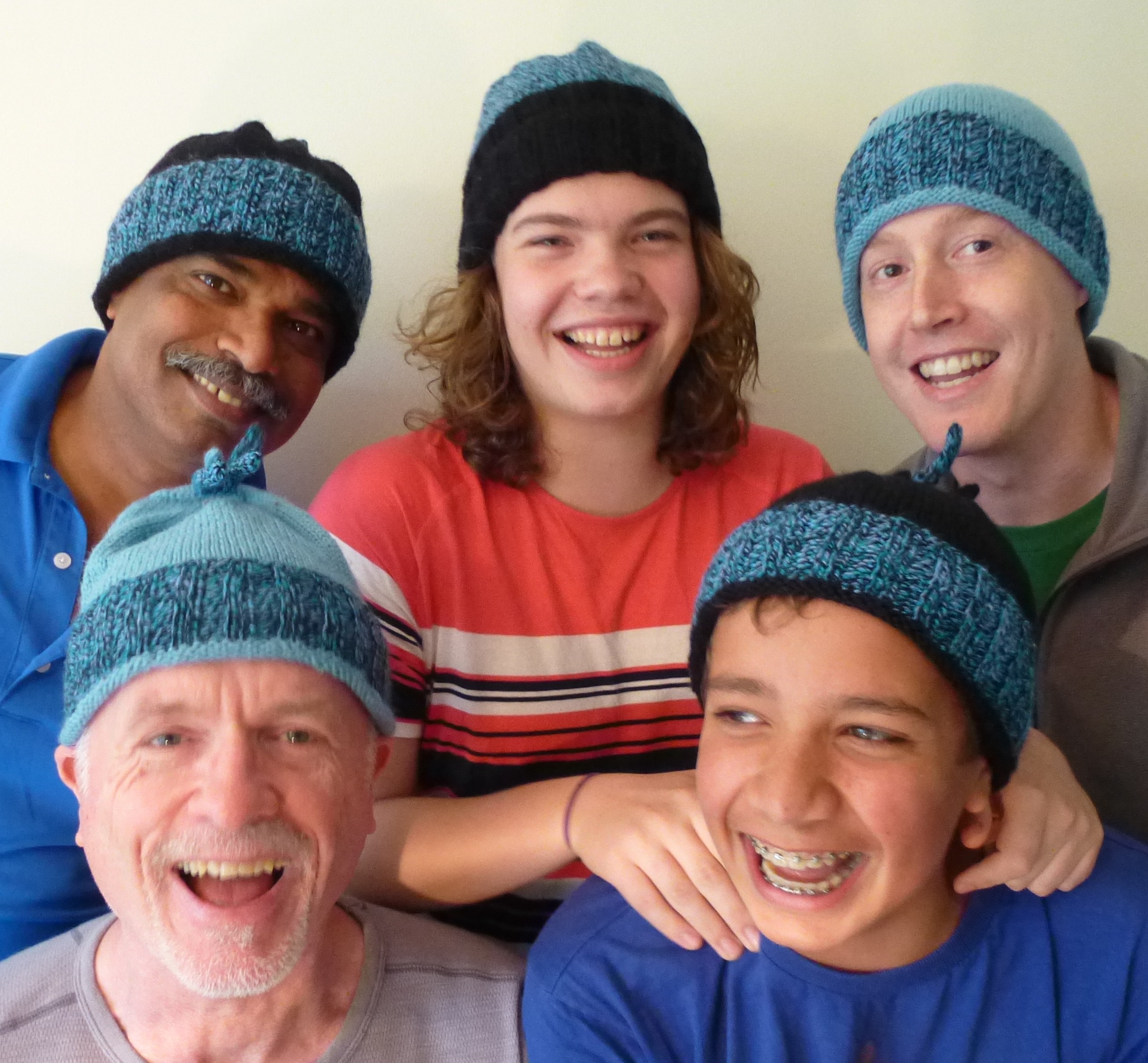
Watchcaps with three ply handspun combined with plain commercial yarn

Watchcaps with three ply handspun combined with plain commercial yarn

We actually had a lot of fun.  Here is my son Jacob (centre top) sharing a laugh with (clockwise) his cousins, Jeremy and Jay and his uncles Will and Surya.  They are wearing a set of watch caps I did featuring handspun (the 3-ply blue/turquoise/black) and King Cole Antitickle DK.  I made these when I was flirting with the idea of selling this kind of hat.  The relationship floundered.

Lest we Forget

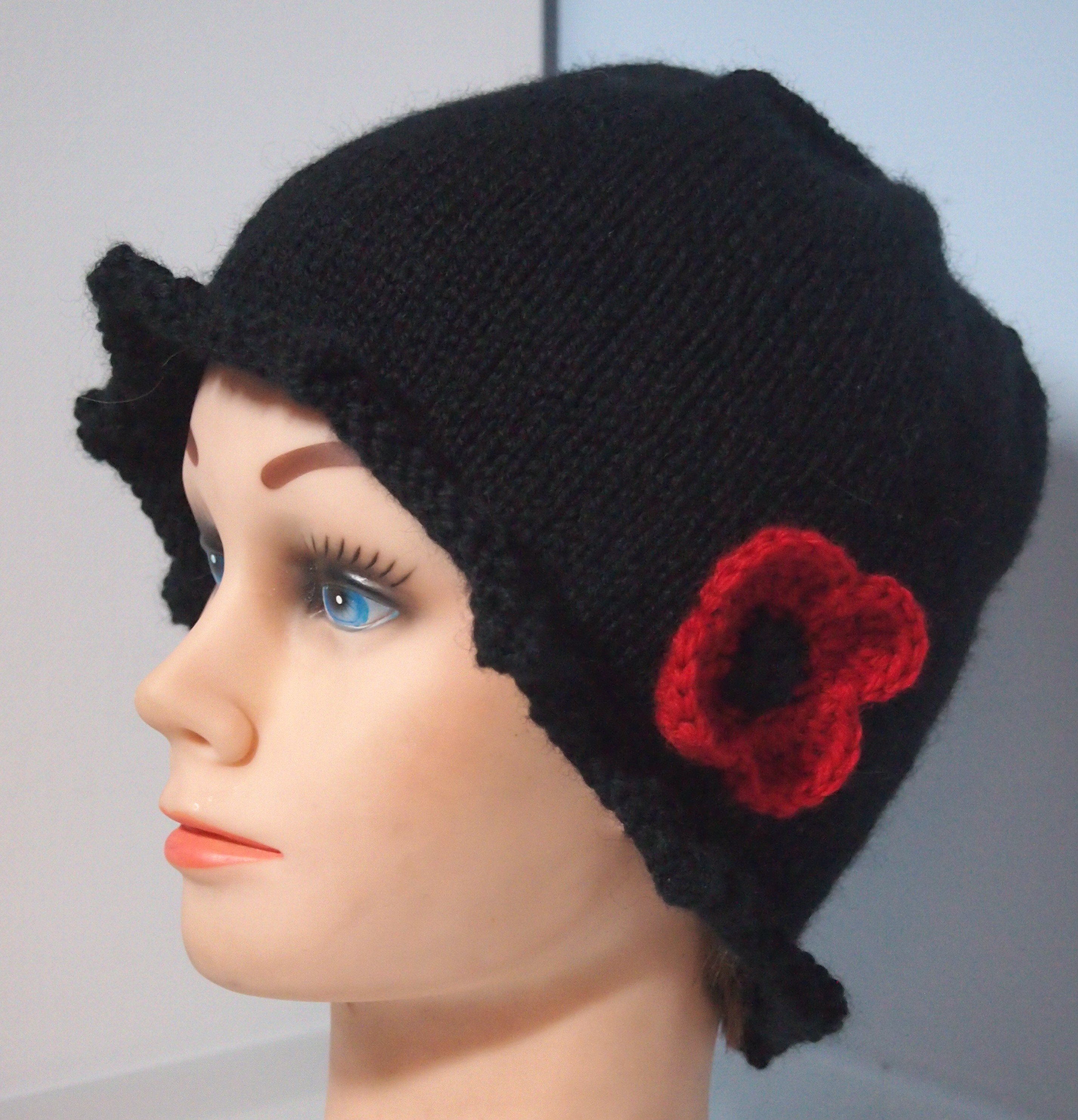
Remembtance Day hat, felted version

Remembtance Day hat, felted version

I had the idea for this Remembrance Day hat a couple of weeks ago.  it was supposed to be a felted version of a twenties cloche with a crocheted poppy.  I think I have discovered on Halloween and today why knitted felting was a short lived fad.  Firstly a felted hat has at least 50% more stitches in it than a regular hat because of the shrinkage.  Secondly, the washing machine turns into a real crapshoot.

Remembrance Day hat, unfelted version

Remembrance Day hat, unfelted version

unfelted version, top view

unfelted version, top view

I spent the last couple of days off and on knitting the felted hat.  I mapped it out on paper and used the (newly recovered) tension square that I had made and lost for the witches hat on Halloween to calculate the stitches. I knitted and knitted, and then put it in the washer and dryer.  I got a pattern for the crocheted poppy from Treasures in Needlework by Mrs Warren and Mrs Pullan, 1870, and threw it in the laundry with the hat.  This morning I got them out and found what I thought was a shapless, unusable mess.

I then set about spending today knitting the second (unfelted) hat and making a scaled down crocheted poppy from my head.  Now I am not sure which one is better.

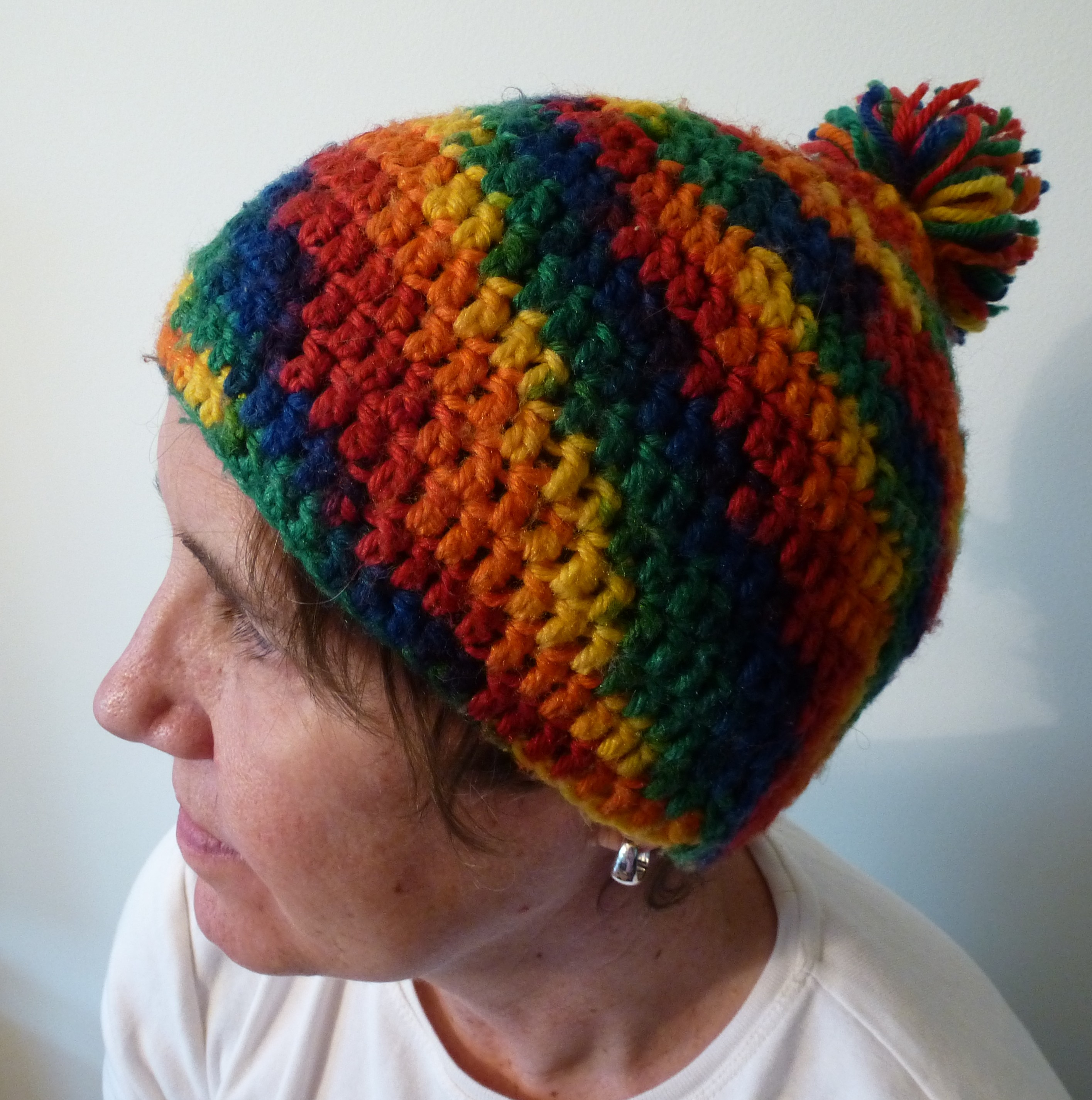
Rainbows, rainbows everywhere

Ben in a rainbow

Ben in a rainbow

I love rainbows.  Off the top of my head I remember making stained glass rainbows, knitted rainbows, crocheted rainbows and felted rainbows.   Alan once called me a fibre snob…I only like working with natural fibres.  This is not actual snobbery, I just don’t like the feel of synthetics through my fingers. Unfortunately, it is sometimes easier to get a rainbow in synthetics than natural.  I think both of these hats are made with synthetics.  I made them a while ago and don’t remember out of what.

Jane in another..crocheted

Jane in another..crocheted

A couple of hats with handspun

Hats made with handspun and commercial dk yarn

Hats made with handspun and commercial dk yarn

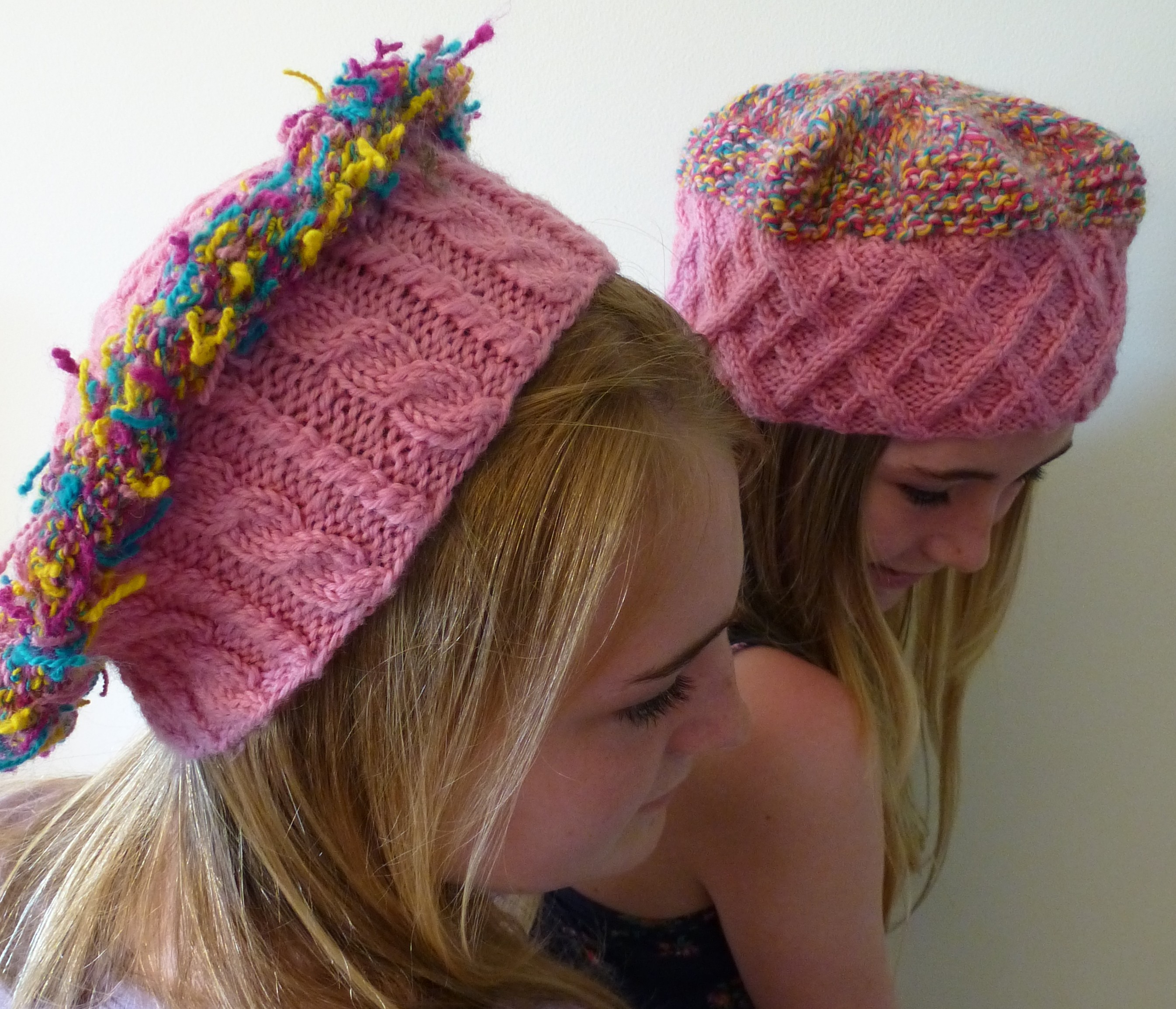
Meg and Sarah wearing hats featuring handspun

Meg and Sarah wearing hats featuring handspun

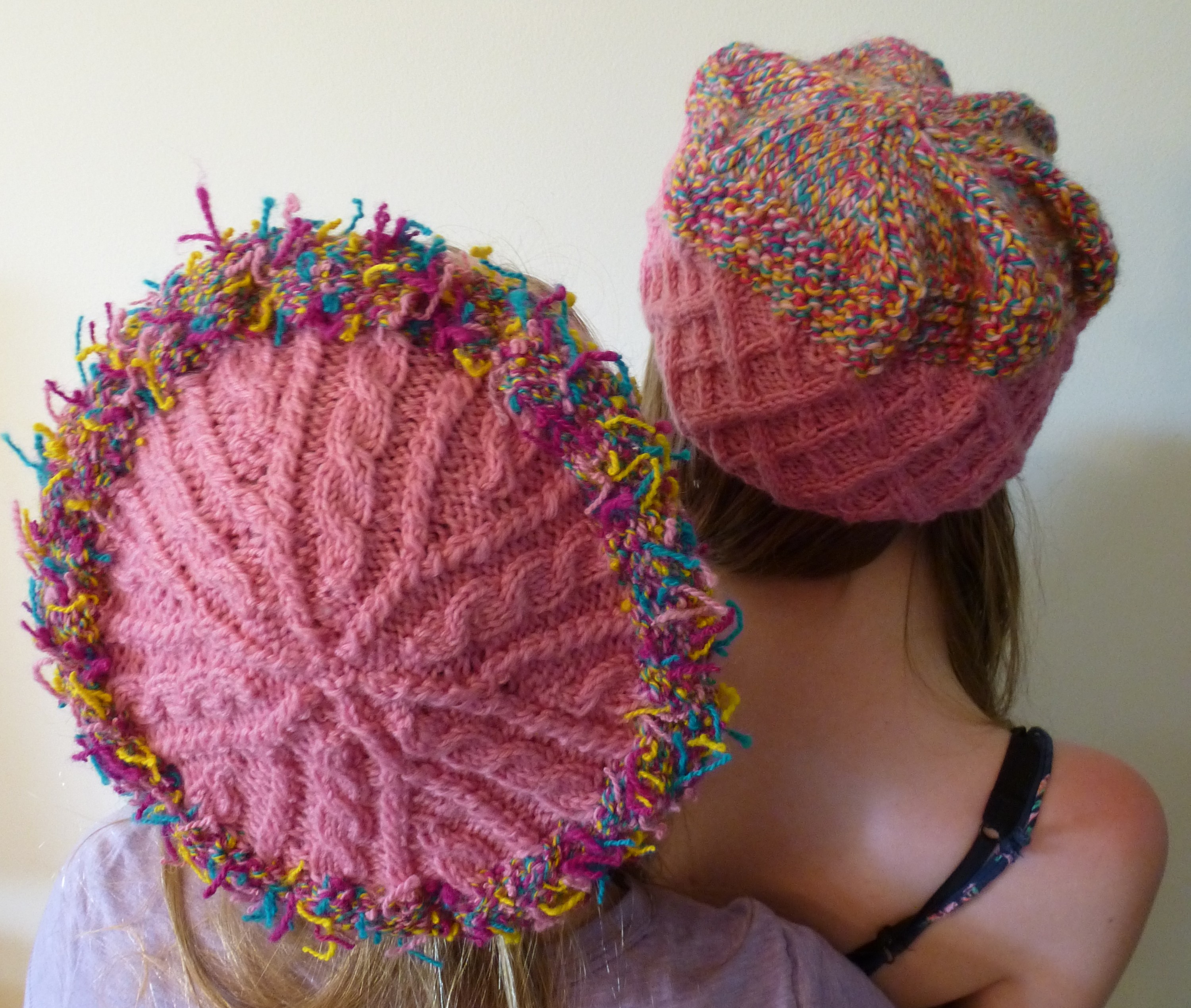
These are two of the hats I made when I was taking my Ontario Handspinners Certificate.  The one on the left was made with practice yarn for the ‘Snarl Yarn’ in the novelty yarn unit.  The other hat is made with a 4-ply from the fictitious line of yarns I made for my final project.  The plain pink yarn in this case was my then favourite yarn, King Cole antitickle DK.  My concept was to use a commercial yarn to showcase the handspun.  This serves a second purpose of stretching the handspun, which is, of course, pretty labour intensive.

Thrums

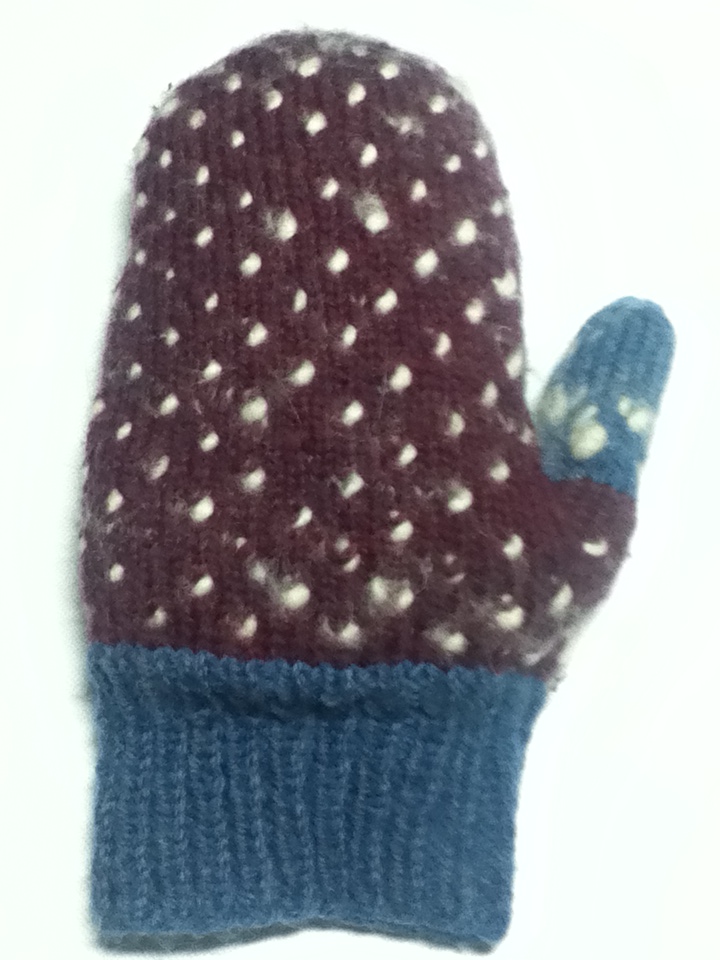
Thrummed mitten

Thrummed mitten..a bit the worse for wear

I hate doing thrums…I can’t say why but it is the only thing (besides sewing up) that I really hate to do in knitting.  The hatred is completely irrational but completely real.  Which proves how much I love my husband because I have made him not just one, but two pairs of thrummed mittens.  For those that don’t know, he is a rampant cyclist and he commutes an hour each way on his bicycle on all but a handful of days a year.  Unfortunately for him, he also suffers from Reyes syndrome (poor circulation in the hands).  This used to lead to his fingertips cracking in the winters.  It was painful and also meant months where he legitimately could not do any dishes (from a purely selfish viewpoint). ANYWAY…his first pair of thrummed mittens solved the problem, at least until, sadly, he lost one of them in a downtown meeting, never to be seen again.

Alan in his 'thrummed' hat

Alan in his ‘thrummed’ hat

So, feeling sorry for him and not looking forward to a winter of solo dish washing, I made him a pair of thrummed mittens for Christmas.  I liked the way they looked so I made a fake thrummed hat to go with them.  No fleece inside this baby.

A Not Unpleasant Hat…

Nicky in a not unpleasant hat

Nicky in a not unpleasant hat

a not unpleasant top view

a not unpleasant top view

As I was leaving the Ottawa Knitters Guild meeting one night, someone was knitting with the fuchsia yarn in this hat.  I commented that I thought it was nice.  She said something like ‘here take it…I don’t like it and I was going to throw it out’.  I came home and started making this hat.  The next day my oldest sister, Jane, came to visit.  She watched the hat grow and when it was finished, she said (in a surprised voice)…’that’s actually not an unpleasant hat’….high praise, indeed..be still my heart!

Mentors I’ve never met…Meg Swansen and Elizabeth Zimmerman

I am sure almost every serious knitter who read the title said to themselves ‘how original…they are everyone’s mentors’.  I love what this mother and daughter team has done for the knitting community.  I appreciate the intellectualism that they, together and individually, have fostered in the world of knitting.  My husband Alan bought me Meg Swansen’s book ‘A Gathering of Lace‘ for Christmas because I usually knit a couple of lace shawls a year, mostly from 1860’s patterns to put in the fall fair at work.  The reference pages and construction notes throughout this book are total gems.  Want to know how to knit backwards (entrelac anyone?)…its in there..pg. 164.  Want to know how many stitches you need to increase to keep your knitting flat?…its in there too..Elizabeth Zimmerman’s Pi Shawl Shaping..pg 38.  I used this math formula to keep the brim of my witch’s hat flat.  Worked like a charm…

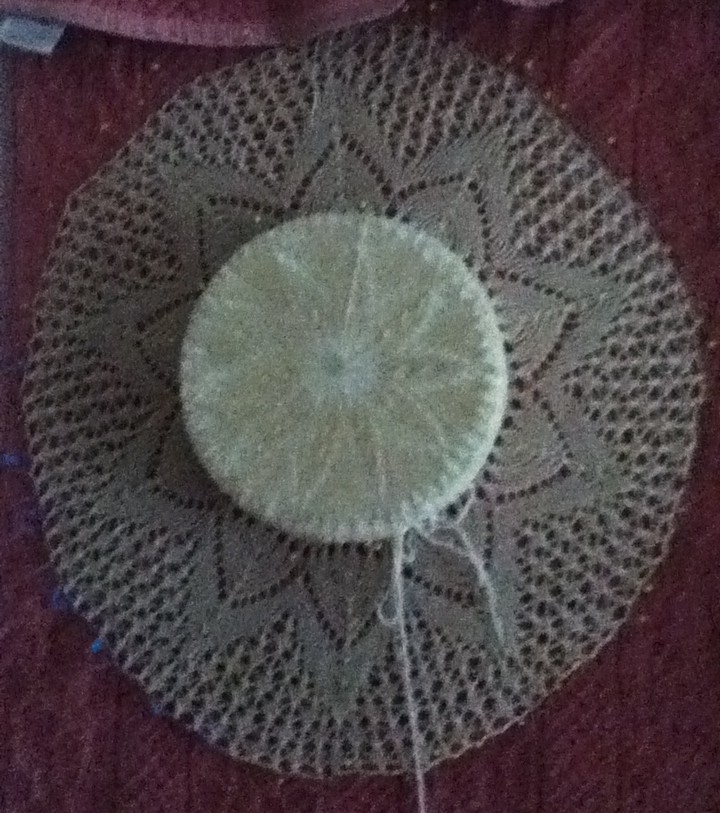
lace hat from A Gathering of Lace.

lace hat from A Gathering of Lace.

This book contains the pattern for the only hat I have made from someone else’s pattern in several years. Here it is being blocked.  In case you are wondering, that is a 3″ high, 7″ diameter styrofoam cake form blocking the main part of the hat.  These would normally be used for fake wedding cakes and are available anywhere cake decorating supplies are sold. I taught cake decorating for many years and this was kicking around the house.  I thought it would work well for this purpose. This gives you a 22″ hat diameter, which is good for most women.  You could always cinch it in a bit with a decorative ribbon or a hatband if you want.

The hat in the picture and the witch’s hat both have real problems with floppy brims which I need to solve at some point.  But they both look great on a table….Maybe some old fashioned starch will do the trick.  I put some in this hat when I wet it for blocking, but maybe not enough,  The brim sagged almost immediately.

I thought I remembered, back in the 80’s, a show called ‘Knitting with Meg’ on PBS, but I can find no reference to it.  I used to organize my Saturday mornings around it.  I remember being totally psyched that there was actually a show about knitting on TV.  I hope it was her.